
How Voltage Drop Impacts Long-Run LED Strip Installations
LED strip lighting performance often drops in long installations due to voltage loss across wiring and connections. What looks fine at installation can later lead to uneven brightness, color inconsistency, and early driver failure.
Voltage drop doesn’t usually come up when people talk about lighting design. Most of the time, it only shows up after something feels off.
A run that isn’t as bright as expected. Colors that don’t quite match from one end to the other. Drivers that seem fine at first and then start failing earlier than they should. In long LED strip installations, voltage drop sits behind all of that.
The problem is timing. When voltage drop isn’t considered during design, the system often looks fine at install. Everything turns on. Output seems acceptable. The issues surface later, when fixing them means opening walls, rerouting power, or replacing hardware that wasn’t actually the root cause.
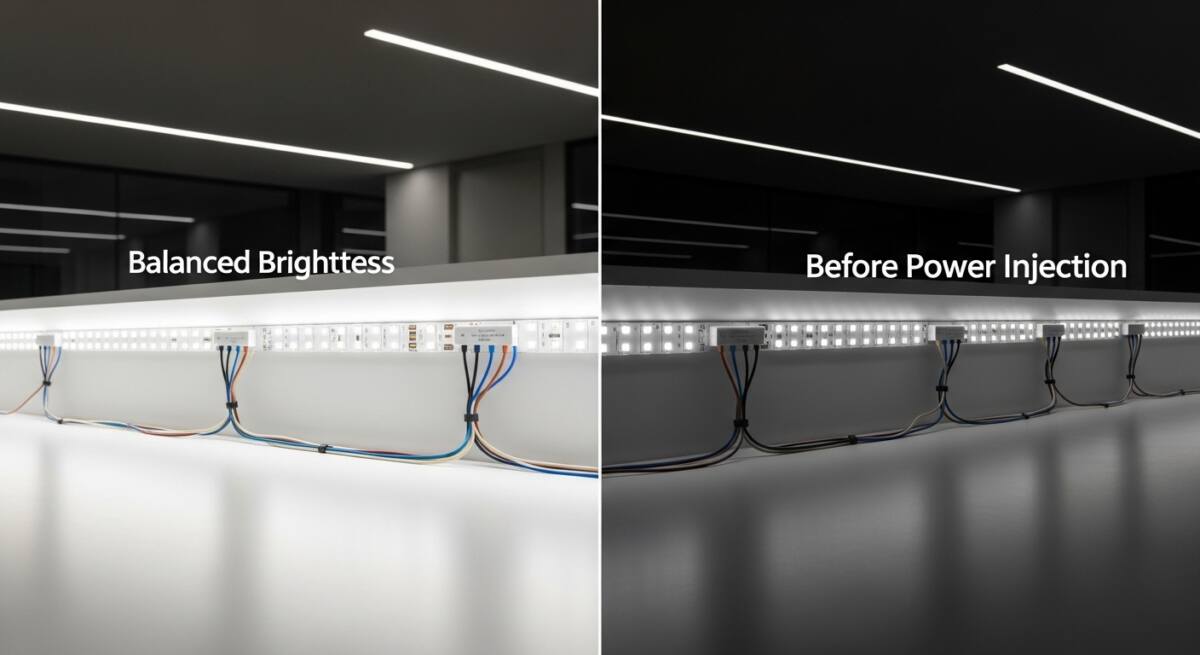
Why Voltage Drop Becomes a Real Problem in Long Runs
Short LED strip runs are forgiving. Long ones aren’t.
As distance increases, resistance adds up. It doesn’t happen all at once. It builds across wiring, copper traces, connectors, and every transition in between. Voltage slowly falls as current moves farther from the power source.
The lights still turn on. That’s what makes this tricky. But they’re no longer operating in the range they were designed for.
This is why long-run installations can pass testing and still fail down the line. The U.S. Department of Energy has repeatedly pointed out that power quality and electrical design issues are a major contributor to early LED and driver failure in real-world installations. Voltage drop is one of the most common of those issues in low-voltage lighting systems.
By the time it becomes obvious, the damage has usually already started.
What Voltage Drop Is and Why It Happens
Voltage drop is the loss of electrical pressure as current flows through a conductor. Every conductor resists current. That resistance converts some electrical energy into heat. As distance increases, more voltage is lost before reaching the LEDs. In LED strip systems, voltage drop occurs across:
- Supply wiring
- LED strip copper traces
- Connectors, terminals, and splices
This behavior follows basic electrical laws. It is predictable. It is measurable.
How Voltage Drop Actually Shows Up in LED Strip Installations
Voltage drop does not usually cause sudden failure. It creates gradual, often confusing symptoms.
Uneven Brightness Along the Run
The section closest to the power source appears brighter. Output fades toward the end of the strip as voltage falls below optimal operating levels.
Color Shift and Color Inconsistency
In RGB systems, voltage drop can cause certain color channels to drop out sooner than others. Reds may remain while blues and greens weaken. In white strips, color temperature may vary along the run.
Flickering and Unstable Operation
When voltage approaches the minimum operating range of drivers or dimmers, the system may flicker or cycle. This is often misdiagnosed as a controller issue.
Increased Electrical Stress
Even when brightness looks acceptable, drivers may be compensating internally. That compensation generates heat and shortens component life.
Why Low-Voltage LED Strips Are More Affected Than High-Voltage Systems
Low-voltage systems require higher current to deliver the same power. Higher current increases voltage loss across conductors. This is why low-voltage LED strips are more sensitive to voltage drop than high-voltage lighting systems.
Current Comparison Example
| System Type | Operating Voltage | Approx. Current for 60W Load |
|---|---|---|
| Low-voltage LED strip | 12V DC | 5.0 A |
| Low-voltage LED strip | 24V DC | 2.5 A |
| High-voltage fixture | 120–240V AC | <0.5 A |
As current increases, voltage drop and heat increase with it. Even small voltage losses represent a large percentage of total voltage in 12V systems.
Voltage Drop Is a System Design Issue
This distinction matters. Voltage drop is not caused by “bad LED strips.”
It is not a driver flaw.
It is not something software can fix.
Voltage drop is the result of design decisions:
- Run length
- Wire size
- Power placement
- Load distribution
- Operating voltage
When these factors are ignored, even high-quality components operate under stress.
Design Factors That Increase Voltage Drop in Long Runs
Voltage drop rarely has a single cause. It is usually cumulative.
Primary Contributors
| Design Factor | Why It Matters |
|---|---|
| Long continuous runs | Increase resistance over distance |
| High wattage per foot | Increases current draw |
| Undersized wire | Raises resistance and heat |
| Poor connections | Add resistance at every joint |
| Elevated temperature | Increases conductor resistance |
Each factor alone may seem minor. Together, they create measurable voltage loss.
How Voltage Drop Impacts Power Supplies and Drivers Over Time
In regulated systems, voltage drop often stays hidden. When input voltage falls, drivers increase internal effort to maintain output. This raises internal temperature and accelerates aging of key components such as capacitors and switching devices.
The U.S. Department of Energy has documented that excess thermal stress is one of the primary causes of reduced LED driver lifespan, even when light output initially appears stable.
By the time a driver fails, the underlying voltage drop issue often remains.
Proven Design Strategies to Reduce Voltage Drop
Voltage drop will always exist. The goal is to keep it from becoming a problem later.
- Break long runs before they break performance
Pushing power through one long, continuous strip almost always ends the same way, bright at the start, weak at the end. Shorter, powered sections keep the system balanced and predictable. - Feed power where it makes sense, not just where it’s easy
When power enters from one end, everything downstream pays the price. Bringing power closer to the middle or at multiple points reduces how far current has to travel and smooths out output. - Don’t default to voltage, choose it
Higher voltage helps by lowering current, but it isn’t a blanket fix. Run length, load, and environment should decide the voltage, not habit or availability. - Wire size matters more than people think
Undersized wire quietly creates loss and heat. Going slightly thicker often solves issues before they show up and costs far less than fixing them later. - Measure when the system is actually working
Voltage readings taken with the lights barely on mean nothing. If you want real answers, measure under full load. That’s where problems show themselves.
Voltage Drop, Safety, and Electrical Code Considerations
Voltage drop is also a safety issue.
The National Electrical Code recommends limiting voltage drop to 3% for branch circuits and 5% total to ensure proper equipment operation and reduce heat buildup. Excessive voltage drop increases conductor temperature, stresses power supplies, and reduces system reliability.
All line-voltage work should be performed by licensed electricians. Power supplies, wiring methods, and enclosures must comply with applicable codes. UL-certified components provide assurance that products have been evaluated for electrical safety under defined conditions.
Why Voltage Drop Is Expensive to Fix After Installation
Once wiring is concealed, access becomes limited. Troubleshooting takes time. Components are replaced without addressing root causes.
Correcting voltage drop after installation often requires:
- Pulling new wire
- Adding power injection points
- Reworking layouts
- Disrupting occupied spaces
These costs almost always exceed the effort required to design correctly at the start.
Treat Long-Run LED Strip Lighting as an Electrical System
A long-run LED strip installation is not just lighting.
It is an electrical system.
Strip selection, power distribution, wiring, control, and thermal conditions all interact. Ignoring one weakens the entire system.
Successful installations are designed deliberately. They rely on accurate documentation, proper calculations, and early technical review, not assumptions made on site.
Final Thoughts: Design for Stability, Not Just Appearance
Long LED strip runs don’t fail because the lights are bad. They fail because the electrical side wasn’t thought through early enough.
Voltage drop doesn’t break things all at once. It slowly pushes the system out of balance. Output drifts. Drivers run hotter than they should. What looked fine at install starts costing time and money later.
The easiest time to deal with voltage drop is before anything is mounted. That means looking at run length, power placement, wiring, and load together, not as separate decisions. When that groundwork is done right, the system stays stable instead of needing fixes down the line.
If a project involves long runs, it’s worth slowing down at the design stage. SIRS-E supports that process with clear documentation, wiring guidance, and technical support, so the system works the way it’s supposed to, not just on day one, but over time.
Frequently Asked Questions:-
What causes voltage drop in long LED strip runs?
Resistance in wiring, strip conductors, and connections causes voltage loss as current travels distance.
How can I tell if voltage drop is affecting my system?
Uneven brightness, color shift, flicker, and early driver failure are common signs.
Does voltage drop mean the LED strips are poor quality?
No. Voltage drop is a system-level design issue, not a product defect.
Can higher voltage LED systems help reduce voltage drop?
Yes. Higher voltage reduces current and makes voltage drop easier to manage when designed properly.
Should voltage drop be addressed before installation?
Always. Fixing voltage drop after installation is far more difficult and costly.











Leave A Comment
You must be logged in to post a comment.