
How Do Architects Specify Linear LED Lighting Systems?
Most architects don’t lose sleep over whether a linear run looks “nice” in a rendering. What keeps projects clean is what happens underneath: power planning, control compatibility, and whether the system will pass inspection without drama.
That’s the difference between “a strip of led lights” and a lighting system.
LEDs are a big reason linear lighting became the default in commercial work. The U.S. Department of Energy notes that LEDs use at least 75% less energy and can last up to 25 times longer than incandescent lighting.
And at scale, the impact is not small. DOE estimates broad LED adoption could save 569 terawatt-hours per year by 2035, roughly the annual output of more than 92 large power plants.
But those benefits don’t come automatically. If the driver is undersized, if the dimming protocol is mismatched, or if voltage drop is ignored, the “efficient LED system” turns into flicker, uneven brightness, early failures, and rework.
Why Linear LED Lighting Must Be Specified as a Complete System
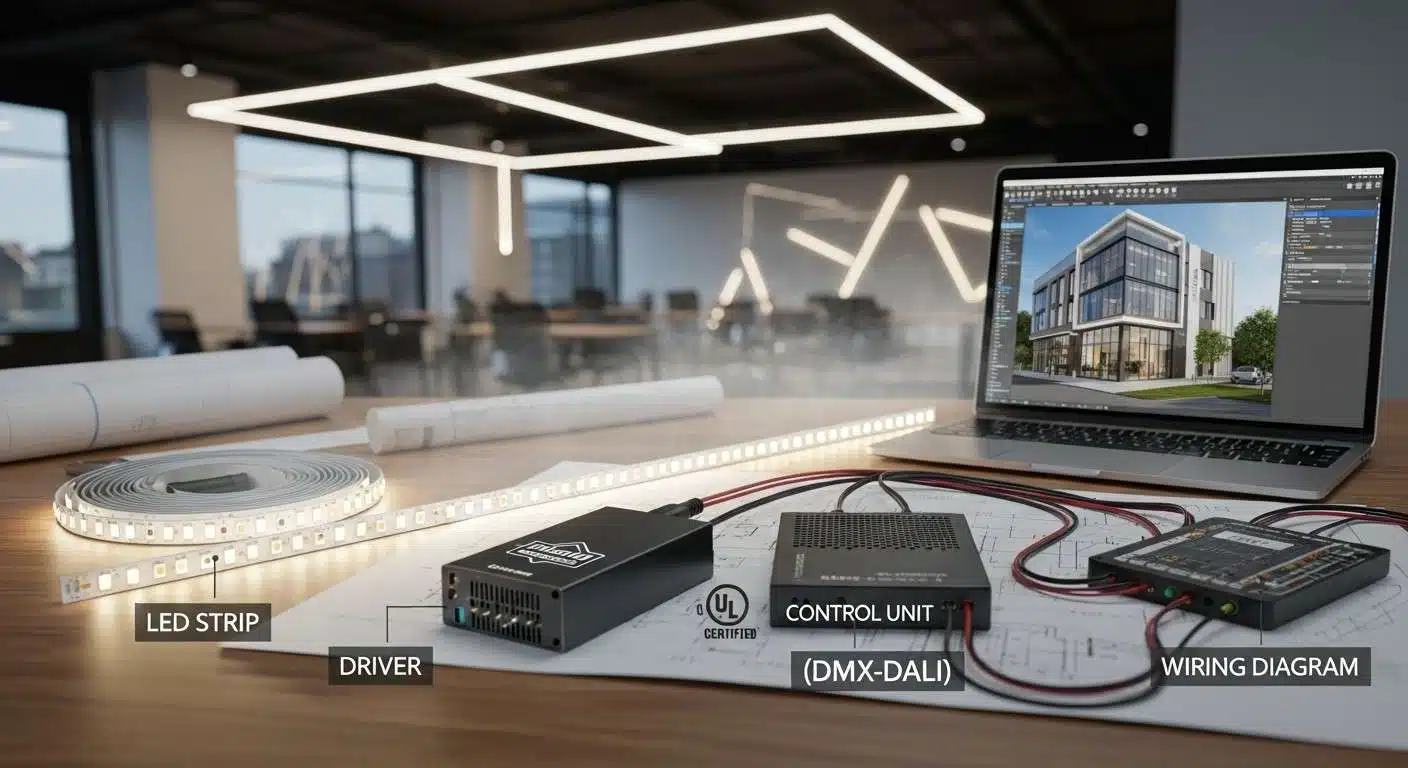
Linear LED lighting isn’t something you spec as a single line item. It’s a chain of decisions that all have to agree with each other.
A real linear LED system includes:
- The LED strip
- The driver (power supply)
- The control method (DMX, DALI, 0–10V)
- The wiring approach and run lengths
- Power injection points (when runs get long)
- Safety compliance, including UL-listed / UL-certified components where required
When one link is off, you’ll see it. Sometimes immediately (flicker, dimming). Sometimes later (overheating, shortened driver life, inconsistent output between zones).
That’s why architects typically sanity-check the system early: voltage and load calculations, control compatibility, and whether the components meet compliance expectations for the job site.
SIRS-E is built around that reality. The products are designed and tested in-house in Texas, with UL-certified options and documentation that supports proper installation. In spec work, that matters because it reduces ambiguity, both during design and at install.
Step-by-Step Process Architects Use to Specify Linear LED Lighting Systems
There’s no single “one-size” spec. But the workflow is consistent: define the lighting need, match it to the right strip and driver, confirm controls, and then validate compliance and serviceability.
Below is the same process architects and integrators rely on to keep linear LED systems stable in the field.
1. Define the Functional Lighting Requirements of the Space
Lighting design begins with purpose. Architects first define how the space will be used.
1.1 Determine Target Illumination Levels (Lux / Foot-Candles)
Light levels are measured in lux or foot-candles. Typical commercial benchmarks include:
| Space Type | Recommended Lux | Foot-Candles | Design Notes |
|---|---|---|---|
| Office Workstations | 300–500 lux | 30–50 fc | Low glare required |
| Corridors | 100–200 lux | 10–20 fc | Uniform guidance |
| Retail Display | 500+ lux | 50+ fc | High CRI preferred |
| Healthcare Corridor | 100 lux (day) / 50 lux (night) | 10 fc / 5 fc | Reduced glare |
Defining these values prevents under-lighting or over-powering the system.
1.2 Identify Task, Ambient, and Accent Lighting
Architects then determine the lighting purpose:
- Direct task lighting
- Indirect cove lighting
- Wall washing
- Accent illumination
Linear LED systems are often used to create uniform light distribution across large surfaces. This requires proper lumen calculations per foot.
2. Select the Correct LED Strip Voltage and Configuration
Voltage selection affects performance stability.
2.1 Choose Between 12V and 24V Systems
- 12V systems are suitable for shorter runs.
- 24V systems reduce voltage drop in longer installations.
- Higher voltage improves brightness consistency across extended runs.
Voltage drop occurs when long strips are powered from one end. The far end can dim due to resistance in copper traces. For long linear runs, architects often specify 24V strips with multi-point power injection.
2.2 Determine LED Density and Wattage Per Foot
Performance depends on:
- LEDs per meter
- Lumens per foot
- Watts per foot
- Component quality
Higher density increases uniformity. Wattage per foot determines driver sizing.
Brightness depends on diode density and internal component design — not diode size alone.
2.3 Specify Color Temperature (CCT) and CRI
Color temperature affects perception and comfort.
Common CCT ranges:
- 3000K – Warm hospitality environments
- 3500K–4000K – Offices and mixed-use spaces
- 5000K – Industrial or high-task areas
CRI (Color Rendering Index) measures color accuracy:
- CRI 80+ for general commercial use
- CRI 90+ for retail and product displays
Proper CRI improves visual clarity and occupant comfort.
3. Calculate Power Load and Size the LED Driver Properly
Improper driver sizing causes flicker, overheating, and early failure.
3.1 Calculate Total System Wattage
Use this formula:
(Watts per foot × Total length) × 1.2 safety factor
Example:
- Strip = 4.8W per foot
- Length = 20 feet
- Total = 96W
- Add 20% margin → Minimum 115W driver
This margin prevents driver strain.
3.2 Prevent Voltage Drop in Long Linear Runs
Best practices:
- Power injection from both ends
- Multi-feed wiring
- Avoid single-end power for long strips
These steps ensure consistent brightness.
3.3 Verify UL-Certified Drivers and Components
UL certification confirms:
- Electrical safety testing
- Fire resistance compliance
- Code inspection approval
Specifying UL-certified systems reduces risk during inspection and protects project liability.
SIRS-E designs UL-certified LED strips and compatible drivers specifically for professional installations.
4. Integrate Lighting Controls Early in the Design Phase
Lighting controls affect both flexibility and energy use.
4.1 Compare Control Protocols for Linear LED Systems
| Control Type | Application | Key Benefit |
|---|---|---|
| DMX512 | Dynamic color control | 512 channels |
| DALI / DALI-2 | Commercial automation | Two-way communication |
| 0–10V | Basic dimming | Simple integration |
| Occupancy Sensors | Energy savings | Automatic shutoff |
| Daylight Harvesting | Perimeter lighting | Reduced runtime |
DMX512 systems are often used in architectural, creative, and large commercial projects requiring channel-based precision.
4.2 Understand Energy Savings from Controls
Research published in Energies shows occupancy-based lighting controls can reduce lighting energy use by over 30% in commercial buildings.
Controls extend system lifespan and reduce operational carbon impact.
5. Address Flicker, Dimming, and Video Compatibility
Flicker affects visual comfort and camera environments.
5.1 Common Causes of Flicker
- Undersized drivers
- Incompatible dimming protocols
- Low refresh rates
5.2 Specify High-Frequency Drivers for Camera Environments
Conference rooms, studios, and creative installations require high refresh rate drivers. Systems operating at higher kilohertz frequencies (for example, 5.2kHz) reduce visible flicker on camera.
Flicker control is a system-level consideration, not a cosmetic fix.
6. Ensure Electrical Code Compliance and Safety
Safety must be confirmed before installation.
6.1 Why UL Certification Is Critical
UL certification ensures:
- Electrical testing
- Fire safety compliance
- Inspection readiness
Commercial projects often require documented compliance.
6.2 Use Licensed Electricians for Installation
Linear LED systems involve low-voltage electrical wiring. For safe installation, consult a licensed electrician and follow local electrical codes.
7. Plan for Longevity, Maintenance, and Serviceability
Architects should plan for lifecycle performance.
7.1. LED Lifespan Expectations
The U.S. Department of Energy states LEDs typically last 25,000 to 50,000 hours or more, depending on design and heat management.
Thermal management and proper driver sizing influence lifespan.
7.2 Design for Replaceable Components
Specify systems that allow:
- Replaceable drivers
- Modular strip sections
- Accessible wiring paths
- Documented wiring diagrams
SIRS-E provides technical documentation and responsive support to ensure proper implementation.
Common Specification Mistakes Architects Should Avoid
Even experienced teams run into avoidable issues with linear LED systems. Most problems show up after installation. Here are the ones that matter most.
1. Ignoring Voltage Drop in Long Runs
Long LED runs powered from one end often dim at the far end. That’s voltage drop.
For extended coves or perimeter lighting, architects should:
- Use 24V systems instead of 12V
- Plan dual-end power injection
- Avoid single-feed long runs
Uniform light must be engineered. It doesn’t happen automatically.
2. Undersizing Drivers
A 96W load does not get a 100W driver.
Drivers running at full capacity overheat and fail faster. Always add at least a 20% safety margin.
Correct sizing improves stability and lifespan.
3. Mixing Incompatible Dimming Systems
DMX, DALI, and 0–10V are not interchangeable.
When protocols are mismatched, you get:
- Flicker
- Stepped dimming
- Control failures
Confirm compatibility before final specification, not during commissioning.
4. Using Non-Certified Components
Commercial projects require inspection. Certification is not optional.
UL-certified systems provide documented electrical safety validation. That reduces inspection risk and liability exposure.
5. Assuming All LED Strips Perform the Same
Two strips may look identical on paper but perform very differently over time.
Performance depends on:
- PCB quality
- Copper thickness
- Component consistency
- Driver pairing
Professional-grade components maintain output and color stability longer.
Why Architects Choose U.S.-Manufactured, UL-Certified LED Systems
In commercial projects, reliability matters more than short-term savings. Here’s why many architects prefer U.S.-engineered, UL-certified systems.
1. Engineering Accountability
When products are designed and tested in-house, technical questions get clear answers. That improves integration and reduces surprises.
2. Traceable Manufacturing
Controlled manufacturing improves consistency between batches. That predictability is critical in large projects.
3. Clear Documentation
Accurate wiring diagrams and load guidance prevent installation mistakes and reduce commissioning delays.
4. Responsive Technical Support
Local support speeds resolution. That protects timelines.
5. Verified UL Compliance
UL certification confirms electrical safety testing and inspection readiness — especially important in commercial environments.
SIRS-E designs and manufactures UL-certified LED strip systems in Texas, providing engineered, documented solutions for commercial and architectural applications.
Linear LED Specification Requires Engineering Discipline
Specifying linear LED lighting systems requires precision.
Architects must:
- Define illumination targets
- Choose proper voltage
- Calculate driver sizing
- Integrate control systems
- Verify UL compliance
- Plan for serviceability
When these elements align, lighting enhances architecture while delivering safety, efficiency, and long-term performance.
Explore UL-certified LED strip systems, DMX controls, and professional drivers at SIRS-E to support your next architectural lighting project.
Frequently Asked Questions:
1. How do architects calculate LED driver size for linear lighting?
Multiply total strip wattage by 1.2 to add a 20% safety margin.
2. What voltage is better for long linear LED runs?
24V systems reduce voltage drop and maintain consistent brightness over longer distances.
3. What lux level is recommended for office lighting?
Most offices require 300–500 lux (30–50 foot-candles).
4. Why is UL certification important in commercial LED systems?
It verifies electrical safety and supports inspection approval.
5. Can DMX512 control linear LED strip systems?
Yes. DMX512 supports up to 512 channels for dynamic color and intensity control.