
How to Design Long-Run LED Strip Installations Without Brightness Loss
Architectural and commercial spaces use linear LED lighting because it produces continuous straight light patterns. The system experiences problems because its operational length exceeds its design capacity. The section near the power source may appear bright while the far end becomes dim.
LED strips usually work correctly because the main issue lies within the power distribution system which runs throughout the installation. The problem usually comes from how electrical power is distributed along the run.
As buildings implement new efficient lighting systems LED usage keeps increasing. The U.S. Department of Energy estimates that widespread LED use could save about 569 terawatt-hours of electricity each year by 2035. This amount equals the electricity production of more than 90 large power plants.
The use of LED lighting in large scale projects requires proper electrical design to ensure that all areas maintain uniform brightness throughout extended distances.
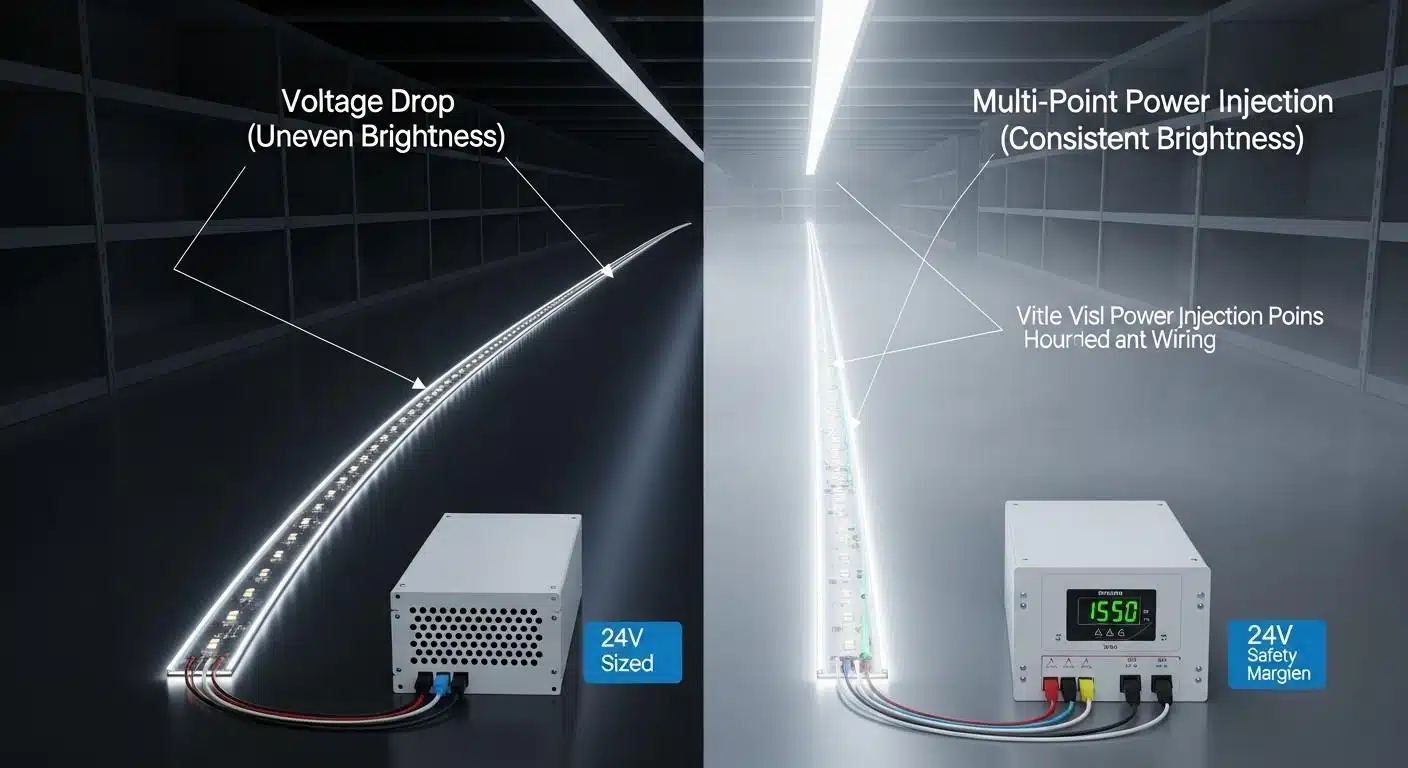
Why Long LED Strip Runs Often Lose Brightness
LED strips operate using low-voltage direct current, usually 12V or 24V DC.
As electricity travels along the copper traces inside the strip, some energy is lost. This loss occurs because every conductor has resistance. Engineers refer to this effect as voltage drop. Voltage drop becomes noticeable when LED strips run long distances without proper power distribution.
The result is easy to recognize:
- LEDs near the power supply appear bright
- LEDs farther away appear dimmer
- brightness becomes uneven
- color output may shift slightly
The longer the strip, the more visible the effect becomes.
Short LED runs may not show the issue at all. However, long architectural lighting lines, commercial shelving installations, or studio lighting setups can reveal voltage drop very quickly.
Common Causes of Brightness Loss in LED Strip Systems
Several factors can reduce brightness across long LED installations. In many cases, more than one issue is present.
| Issue | What Happens | Result |
|---|---|---|
| Voltage drop | Electrical power decreases along the strip | LEDs dim toward the end |
| Undersized power supply | Power supply cannot deliver required current | Flickering or unstable lighting |
| Power from one end only | Electricity travels entire strip length | Uneven brightness |
| Long continuous runs | Resistance increases across distance | Reduced LED output |
| Thin wiring | Power delivery becomes inefficient | Voltage loss and heating |
Most brightness problems trace back to one core issue: how power is distributed across the LED strip system. Fortunately, there are proven solutions that prevent these problems.
Understanding Voltage Drop in Linear LED Installations
Voltage drop results from electrical energy loss which occurs when current flows through a conductor. LED strip lighting uses its copper strip path as the electrical conductor which carries the current. The copper traces carry current which causes resistance to decrease the voltage that reaches the LEDs located at the end of the strip. LED brightness decreases when voltage levels drop.
How Electrical Resistance Affects LED Strips
Resistance exists in every electrical conductor. The longer the conductor, the greater the resistance.
LED strips contain thin copper traces designed to carry electrical current along the strip. Over longer distances, these traces reduce the voltage reaching the final LEDs.
Why High-Power LED Strips Experience Voltage Drop Faster
Higher-density LED strips draw more current. That increased current produces more voltage loss along the copper traces.
High-output lighting systems therefore require better power distribution planning.
How Strip Length Influences Lighting Performance
A short LED strip might only lose a small amount of voltage. Over longer distances, the loss accumulates.
This is why long lighting runs require additional electrical design strategies.
Choosing the Right LED Voltage for Long Linear Lighting Runs
LED strips are available in several voltage configurations. The voltage selected for the installation has a direct effect on how well the system performs over long distances.
Higher-voltage LED strips generally experience less voltage drop because they require lower current to deliver the same power.
| LED Voltage | Typical Use | Voltage Drop Risk |
|---|---|---|
| 5V | electronics and small devices | very high |
| 12V | residential accent lighting | moderate |
| 24V | architectural and commercial lighting | lower |
| 48V | specialized systems | minimal |
12Vresidential accent lightingmoderate
24Varchitectural and commercial lightinglower48Vspecialized systemsminimal
Why 24V LED Strips Perform Better in Long Runs
24-volt LED strips are commonly used in professional lighting installations. They allow longer runs before brightness begins to decrease.
Because current levels are lower, electrical resistance has less impact on the system.
When Higher Voltage Systems Are Used
Large lighting installations sometimes use even higher voltages such as 48V. These systems further reduce voltage drop but require compatible drivers and controllers.
Power Injection Methods That Prevent LED Brightness Loss
Power injection is one of the most effective ways to maintain consistent brightness across long LED strips. Instead of powering the strip from only one end, electricity is introduced at multiple locations along the strip. This reduces the distance that current must travel.
Single-End Power Supply
In this setup, power enters the strip from one side only. This configuration works well for short installations but is rarely suitable for long runs.
Dual-End Power Injection
Power is connected at both ends of the strip. Current flows from each side toward the center, reducing voltage loss along the strip.
Multi-Point Power Injection for Long Installations
Very long LED runs may require power injection every few meters. This method is commonly used in:
- commercial display lighting
- retail shelving installations
- architectural cove lighting
- studio or stage lighting systems
Multi-point power injection ensures that each section of the strip receives stable electrical power.
How to Select the Correct Power Supply for Long LED Runs
Power supply sizing plays a major role in LED system stability. An undersized power supply can cause several problems. Lights may flicker, brightness may fluctuate, and electrical components may overheat. A simple calculation helps determine the correct power supply capacity.
Calculating Total LED Power Requirements
Start by identifying the power consumption per meter of the LED strip.
Then multiply that number by the total strip length.
Example:
LED strip consumption: 14 watts per meter
Strip length: 10 meters
Total required power:
140 watts
Adding Safety Margin to Prevent Power Instability
Power supplies should not operate at full capacity continuously. Adding a 20–30 percent safety margin helps maintain stable operation. In the example above, a 180-watt power supply would be a safer choice.
Why Wire Gauge and Wiring Layout Matter in LED Strip Systems
Wiring is another factor that affects brightness in long LED installations.
Thin wires create additional resistance. That resistance increases voltage drop and reduces lighting performance.
How Wire Resistance Affects Power Delivery
As current travels through wires, electrical resistance reduces the available voltage.
Over long distances, small wires can cause noticeable brightness reduction.
Choosing the Right Wire Thickness for Long Runs
Thicker wires allow electrical current to travel with less resistance.
Proper wire selection depends on:
- total electrical current
- wiring distance
- number of LED strips connected
Selecting the correct wire gauge helps maintain stable power delivery across the system.
Using LED Drivers and DMX Controllers in Advanced Installations
Some lighting installations require advanced control systems.
Drivers and controllers regulate how LED strips operate, including brightness levels and color output.
How DMX Lighting Control Works
DMX512 is a communication protocol widely used in professional lighting.
It allows hundreds of lighting channels to be controlled from a single controller.
DMX systems are commonly used in:
- stage productions
- film studios
- architectural lighting installations
- event lighting environments
When Wireless DMX Systems Are Useful
Wireless DMX transmitters enable control signals to transmit through the air instead of needing extensive data cable installation. This system offers an installation advantage for extensive areas. System design needs to establish proper working conditions which enable controllers, drivers, and LED strips to function together.
Why Certified Components Matter in Professional LED Lighting
LED lighting systems use electrical power for their operational needs. The two main factors that need to be considered in this situation are safety and reliability. The certified components of the system offer users an extra level of security.
What UL Certification Means for LED Lighting Systems
UL certification proves that a product has undergone testing to determine its electrical safety and performance capabilities. Certified lighting components help ensure:
- proper insulation protection
- safe heat management
- reliable electrical operation
- consistent long-term performance
Why Electrical Safety Should Always Be Considered
For large or complex lighting installations, consulting a licensed electrician is recommended.
Professional installation ensures that lighting systems meet electrical codes and operate safely.
Best Practices for Designing Reliable Long-Run LED Strip Installations
Successful LED installations are usually the result of careful planning.
Before installing LED strips, it helps to map out the full electrical layout.
Reliable lighting systems typically include:
- properly sized power supplies
- appropriate wiring gauge
- planned power injection points
- certified LED components
- compatible drivers and controllers
Planning these elements early prevents performance problems later.
Designing Linear LED Lighting Systems That Maintain Brightness
Long LED strip installations can produce clean, modern lighting effects that enhance both residential and commercial spaces.
Maintaining consistent brightness across these installations requires thoughtful electrical design. Voltage drop, power supply capacity, wiring layout, and power injection all influence system performance.
When lighting systems are designed correctly, they operate reliably and deliver consistent illumination across the entire strip.
SIRS-E designs and manufactures UL-certified LED strips, drivers, and lighting control systems in the United States. These products are engineered for reliability and supported with technical documentation and installation guidance.
Frequently Asked Questions:
1. Why do LED strips become dim toward the end?
This usually happens because of voltage drop. As electricity travels along the strip, resistance reduces the voltage available to the LEDs farther away from the power source.
2. How long can an LED strip run without brightness loss?
The maximum length depends on voltage and power consumption. Many 12-volt strips are limited to around 5 meters, while 24-volt strips can support longer runs when powered correctly.
3. What is power injection in LED lighting?
Power injection means supplying electrical power to the LED strip at multiple points rather than only at the beginning. This helps maintain consistent voltage across long installations.
4. Do longer LED strips require larger power supplies?
Yes. Longer strips consume more power. The power supply must be sized to handle the total wattage of the system with additional safety capacity.
5. Should LED lighting systems use certified components?
Yes. Certified components help ensure electrical safety, reliable operation, and compliance with recognized testing standards.