
LED Strip Light Power Supply Calculator
Instantly calculate the correct driver size, wattage, amperage and recommended PSU for your LED strip lighting project — with voltage-drop checks and product matches.
- Works for 12V, 24V & 48V LED strips
- Calculates amps, watts & PSU size
- Voltage drop & wire gauge tools
- Auto 20% safety buffer included
- Supports RGB, RGBW, COB & Tunable
- Commercial & residential use
Advanced: Voltage Drop & Wire Gauge ▾
Wire it right the first time
Reference diagrams for common LED strip wiring configurations — parallel runs, power injection points, and RGB controller wiring.
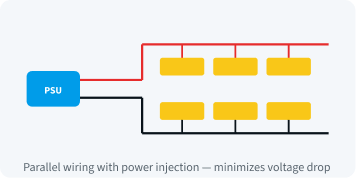
Parallel + Injection
Best for runs longer than 16 ft (12V) or 32 ft (24V).
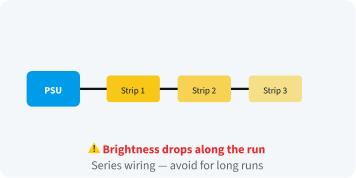
Series Wiring
Causes brightness drop — avoid for long runs.
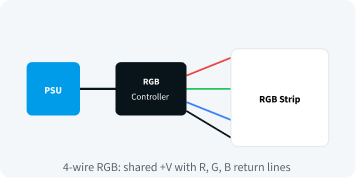
RGB Controller
4-wire setup with shared positive and color returns.
How to size an LED power supply
How to Calculate LED Driver Size
Take the strip’s wattage per foot (or per meter) and multiply by your total run length. That gives you the minimum required wattage. Add 20% for headroom — drivers running near 100% load run hot and fail early.
How Much Power Does LED Strip Use?
Standard density single-color strips draw 3–5 W/ft. High-density and COB strips can exceed 6 W/ft. RGBW can hit 7+ W/ft when all channels are on. Always check the manufacturer’s spec sheet.
12V vs 24V LED Strip Power Requirements
For the same wattage, 24V strips draw half the current of 12V strips. Less current means less voltage drop and longer single runs — 32 ft on 24V vs 16 ft on 12V before injection is needed.
Why You Need 20% Extra Power Capacity
Sustained loads above 80% accelerate capacitor wear and shorten driver lifespan. The 20% buffer keeps temperatures down and gives you margin for inrush current and minor expansion later.
How to Prevent Voltage Drop
Use thicker wire (lower AWG number), shorten runs, inject power at both ends, or step up to 24V. Keep total drop under 3% to maintain even brightness.
Choosing the Right Dimmable LED Driver
Match dimmer to driver: TRIAC for mains dimmers, 0–10V for commercial, DALI for addressable systems, DMX for entertainment. Mismatched protocols cause flicker and audible noise.
Commercial vs Residential LED Drivers
Commercial drivers carry UL Class 2 / Class P listings, higher IP ratings, and protocol compatibility (0-10V, DALI). Residential drivers prioritize cost and TRIAC compatibility for wall dimmers.