
DMX vs Pixel-Mapped Control: Which Should You Use and Why?
Lighting control has moved well beyond simple switching and dimming.
Modern installations carry much heavier expectations. Architectural spaces need precise control across multiple zones. Entertainment environments demand dynamic effects that change by the second. Commercial projects increasingly blend functional lighting with immersive visual experiences that would have been impossible a decade ago.
As those requirements have grown, two primary control approaches have become standard in professional lighting:
- DMX512-based fixture control
- Pixel-mapped LED control
Both technologies control lighting, but they're built to solve completely different problems.
One focuses on structured fixture management. The other focuses on individual pixel-level creative control. That distinction of DMX vs Pixel-Mapped control affects everything: system architecture, installation complexity, scalability, and what the system costs to maintain five years down the road.
Understanding DMX Control Systems
DMX is still one of the most widely used lighting control protocols in professional environments anywhere in the world.
It started in stage lighting and spread from there into architectural, hospitality, commercial, and entertainment applications. The reason it stuck around is simple: it works consistently, across almost every fixture type and manufacturer.
DMX works by assigning channels to fixtures. Each channel carries a value between 0 and 255, letting a controller send instructions covering:
- Brightness levels
- Color selection and mixing
- Effect speed
- Positioning information
- Preset scene changes
Every fixture gets a DMX address and listens only for commands sent to that address range. Everything else gets ignored.
How DMX Control Works
A typical DMX system follows a straightforward communication model. The controller sends data continuously. Fixtures pick out only the information assigned to their addresses and respond accordingly.
In a real installation, it might look like this:
- Fixture A handles ambient lighting
- Fixture B controls architectural accents
- Fixture C manages facade lighting
Each fixture responds independently while staying part of the same overall system.
Why DMX Remains Popular
DMX has stayed relevant because it offers practical advantages that genuinely matter on commercial and architectural projects:
- Proven reliability across decades of real-world use
- Industry-wide compatibility with virtually every manufacturer
- Long-distance communication capability
- Predictable system behavior
- Straightforward troubleshooting when something goes wrong
For a lot of installations, those qualities matter far more than the ability to run complex visual effects.
Understanding Pixel-Mapped Lighting Control
Pixel mapping approaches lighting control from an entirely different angle.
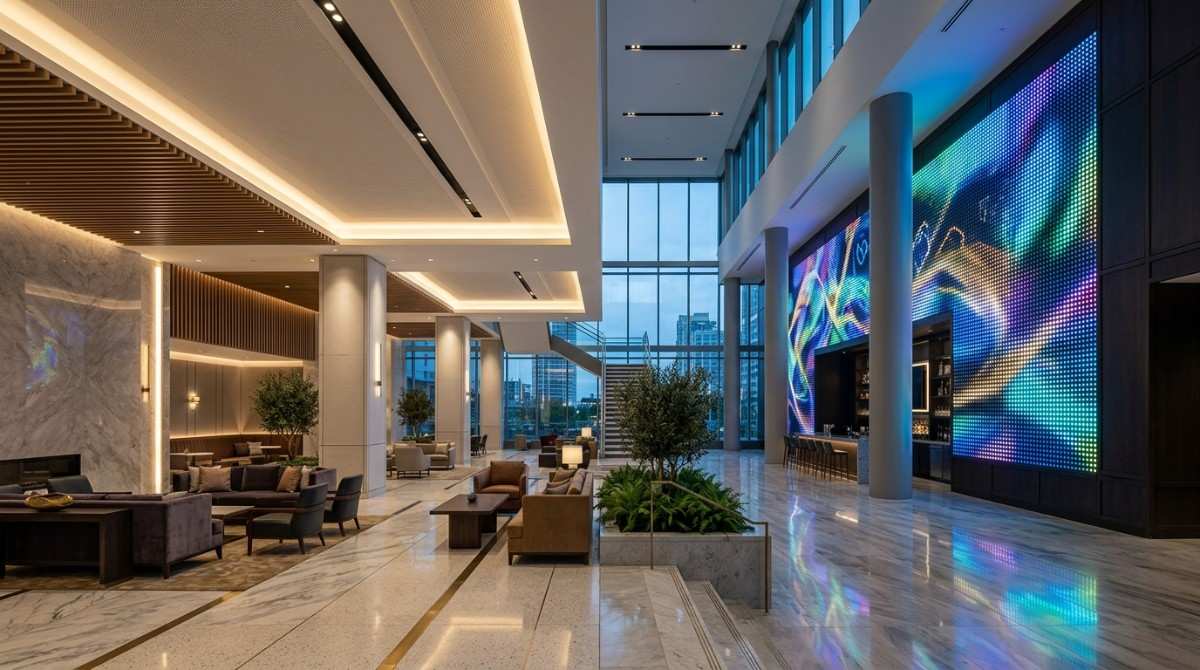
Instead of treating a fixture as a single controllable unit, pixel mapping treats individual LEDs, or small groups of them, as separate controllable elements. The fixture stops being a fixture and starts behaving more like a display.
In a pixel-mapped system, every LED can receive its own unique instructions. Each pixel can show different colors, brightness levels, animation states, and effects, all simultaneously and independently.
That opens up possibilities that simply don't exist in traditional fixture-based control.
How Pixel Mapping Works
Pixel systems use software or dedicated controllers that assign visual content across LED arrays. The system maps data onto the lighting surface, and each pixel responds to its own information independently.
The results can include:
- Animated patterns running across surfaces
- Motion effects and flowing color transitions
- Video-inspired content on architectural elements
- Dynamic color shifts and interactive experiences
Getting this level of control through a traditional DMX fixture setup alone is extremely difficult.
Why Pixel Mapping Is Used
Pixel mapping gets chosen when visual impact is the main objective, not just illumination. Common applications include:
- Media facades on building exteriors
- Entertainment venues and clubs
- Feature walls and experiential installations
- Architectural landmarks where lighting is part of the identity
In these environments, lighting stops being background infrastructure and becomes part of the story the space is telling.
Key Technical Differences
Both systems control lighting, but their design thinking is fundamentally different.
Control Granularity
DMX focuses on fixture-level control. Pixel mapping focuses on LED-level control.
A DMX-controlled fixture changes color as a single unit. A pixel-mapped fixture can display multiple colors simultaneously across different sections of the same fixture. That gap in granularity is the defining difference between the two approaches.
Data Complexity
DMX systems generate relatively modest amounts of control data. A few fixtures might consume only a handful of DMX channels.
Pixel systems are another matter entirely. Thousands of individually controlled pixels generate enormous amounts of control data. As visual resolution increases, system complexity increases right alongside it.
System Structure
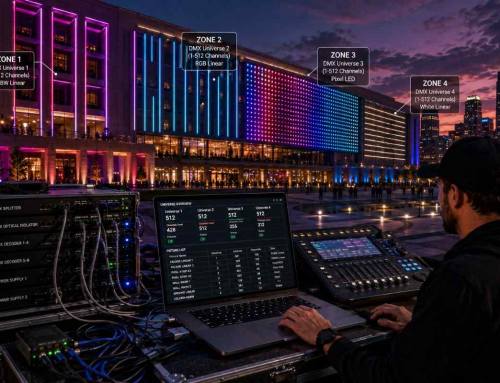
DMX systems are organized around universes, addresses, fixtures, and zones. Pixel systems are organized around pixel counts, matrices, grids, and mapping layouts. That structural difference affects how both systems get programmed and maintained over time.
Infrastructure Requirements
The infrastructure behind each system reflects its control strategy.
DMX Infrastructure
DMX installations need DMX cabling, controllers, nodes or gateways, proper signal termination, and universe planning. The architecture is well understood and familiar to most lighting professionals and electrical contractors.
Pixel System Infrastructure
Pixel installations demand more. High-performance controllers, data distribution hardware, pixel processors, power injection points, and advanced networking infrastructure all come into play.
Because every pixel gets unique information, bandwidth requirements jump significantly. Power distribution also becomes more critical as LED density increases, something that catches people off guard on their first large pixel project.
Design Flexibility and Creative Control
The choice between DMX and pixel mapping often comes down to what the project is actually trying to achieve visually.
The DMX Design Approach
DMX emphasizes consistency and structure. Lighting designers use it to build architectural scenes, layered lighting environments, functional illumination, and controlled transitions. The focus is on supporting the space, making it work well, rather than making the lighting itself the main attraction.
The Pixel-Mapping Approach
Pixel mapping is about movement and visual engagement. Designers can create motion graphics, animated surfaces, dynamic effects, and interactive displays. The lighting becomes part of the visual experience rather than a backdrop to it.
For projects where storytelling and visual impact are the priorities, pixel mapping delivers creative flexibility that traditional DMX systems genuinely can't match.
Scalability Considerations
Scalability matters differently depending on which approach the project uses.
Scaling DMX Systems
DMX scales through multiple universes. Adding fixtures means adding universes, nodes, and expanded network infrastructure. Because the system stays structured throughout, scaling tends to remain manageable. That's a big reason DMX gets used in large architectural projects where the system needs to grow over time.
Scaling Pixel Systems
Pixel systems can scale, too, but it's a heavier lift. As pixel counts grow, data traffic increases, processing requirements climb, network demands intensify, and commissioning gets more involved. Large pixel installations need extensive planning well before installation begins, not during it.
Installation Complexity
The installation experience differs considerably between the two approaches.
DMX Installation
DMX systems are generally straightforward to deploy. Familiar installation practices, simpler addressing, easier troubleshooting, and lower commissioning complexity mean most experienced electrical contractors and lighting integrators can handle them without specialized training.
Pixel Installation
Pixel systems add layers of complexity. Pixel addressing, mapping software, data distribution, synchronization, and calibration all need attention. Commissioning takes real time on larger projects, and rushing it shows in the final result.
Why Hybrid Systems Are Becoming Common
On many professional installations today, the question isn't DMX or pixel mapping. It's how to use both effectively.
Combining Structure and Visual Impact
Hybrid systems let each technology do what it's actually good at. DMX handles ambient lighting, architectural layers, and functional illumination. Pixel mapping handles feature elements, dynamic effects, and media-style visuals. Together, they deliver both the reliability of structured control and the creative range of pixel systems.
A Typical Hybrid Example
An architectural project might use DMX-controlled luminaires for building illumination and pixel-controlled facade elements for dynamic content. The result is a system that handles everyday operation reliably while delivering visual impact when the moment calls for it.
Which Should You Choose?
The answer is based solely on what the project has to achieve.
Choose DMX When:
- The priority is just reliable fixture control
- Zones organize lighting
- Architectural consistency matters
- Long-term simplicity is important
- Large-scale structured control is required
Choose Pixel Mapping When:
- Visual effects drive the project
- Dynamic content is one of the main requirements
- It serves as an invitation to visually experience the installation.
- The main objective is to be flexible.
Choose Both When:
- Functional and decorative lighting must coexist
- Architectural projects include media elements
- Multiple lighting layers in entertainment environments.
- Visual storytelling and practical illumination carry equal weight.
Different Tools for Different Goals
DMX and pixel mapping get positioned as competing technologies. They're not really; they solve different problems.
DMX prioritizes structure, reliability, scalability, and predictable control. Pixel mapping prioritizes visual freedom, animation, and high-resolution creative effects. The right choice depends on project goals, the level of visual complexity required, and what the installation needs to do day in and day out over its operational life.
At SIRS-E, lighting systems are approached from a system-level perspective where control, power, communication, and fixture integration work together. Whether a project relies on DMX, pixel mapping, or a hybrid of both, the objective stays the same: building a control environment that performs reliably while supporting the creative and operational goals of the installation.
Frequently Asked Question's
Can DMX control pixel LEDs?
Yes. It is for commanding pixel systems, but usually commanded at mapped resolutions, DMX can subset thin-medium pixels. A pixel controller will be necessary to operate the full control of all individual High-density pixels in a more dense installation as well.
So now you're wondering: Is pixel mapping better than DMX?
Not as a blanket statement. Pixel mapping provides more visualisation flexibility. DMX has the advantages of a simple and more structured control of the fixtures. Which is better totally depends on the needs of a project.
What is more difficult to install on your system?
This means that pixel mapping is generally more complicated, pixel addressing, mapping software, and controller configuration, as well as greater data requirements, all take time to set up and require more knowledge.
Is it possible for DMX and pixel systems to coexist?
Yes. Hybrid methods, a fairly common approach to professional lighting, allow both technologies to perform different tasks in the same solution.
One of the biggest limitations of pixel systems.
What is the biggest limitation of pixel systems?
The main challenges are increased data load, greater infrastructure requirements, and rising system complexity as pixel counts grow.









Leave A Comment
You must be logged in to post a comment.