
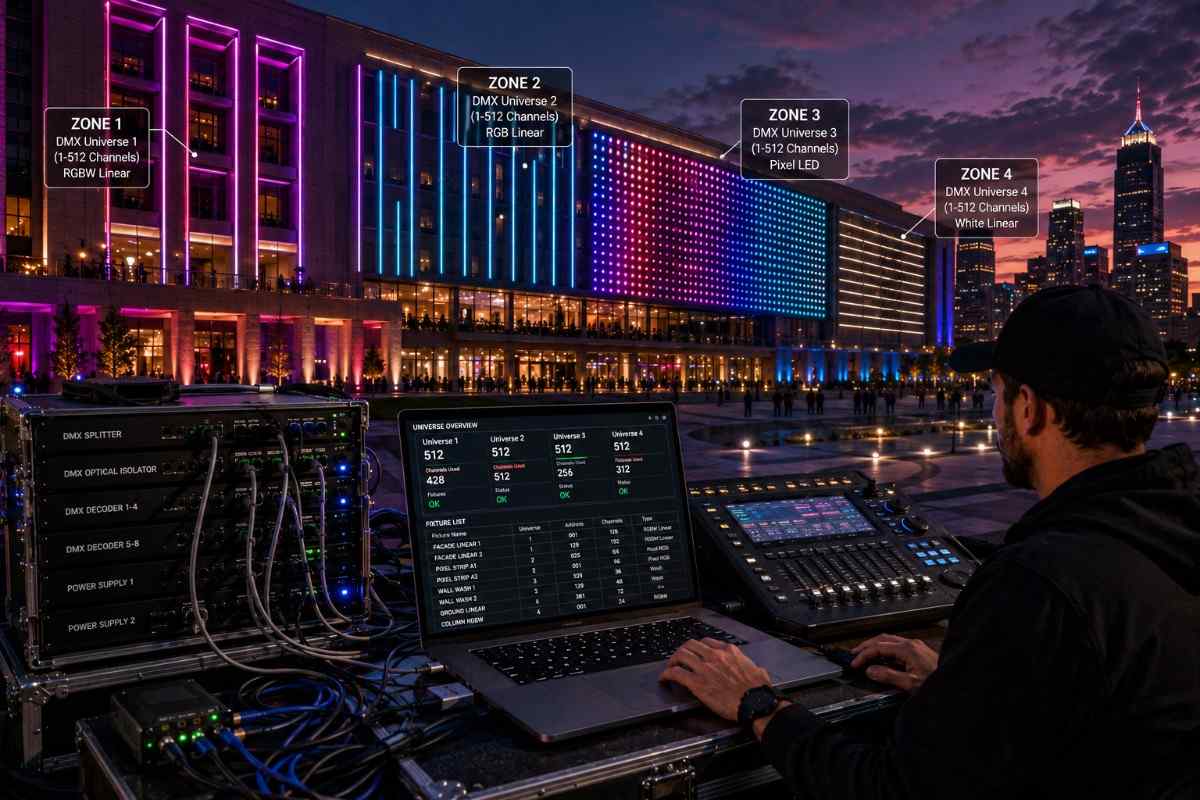
How to Select the Right DMX Universe Size for Large LED Projects
Getting a large LED project right takes more than picking good fixtures. Whether you're lighting up an architectural façade, an entertainment venue, a hospitality property, a museum, or a big commercial installation, the lighting system only works as well as the control infrastructure behind it. And one of the biggest decisions in that whole process is figuring out how many DMX universes the project actually needs.
A DMX universe is basically the backbone of communication between the controller and every fixture connected to it, letting each one receive commands accurately and respond in real time. Get the universe size right, and you end up with a system that's reliable, easier to program, and ready to grow when the project does. Understanding how channel capacity ties into fixture choice and lighting effects is really what lets designers build something scalable instead of something they'll have to rip apart later.
SIRS-E supports these kinds of complex projects with professional-grade, American-made DMX LED strips, controllers, decoders, and integrated lighting solutions built for dependable performance.
What Is a DMX Universe?
A DMX universe is a set of control channels used to talk between a DMX controller and whatever lighting fixtures are hooked up to it. In practical terms, it's the maximum amount of control data that can move through a single DMX line.
Each universe gives you up to 512 individual channels. Every fixture eats up one or more of those depending on what it can do:
- A simple single-color fixture might only need one channel for dimming.
- An RGB or RGBW fixture needs several channels to control color independently.
- Digital LED strips with pixel-level control can get through a lot more, since every pixel or small group needs its own line of communication.
The controller keeps sending commands through these channels, which is what lets fixtures respond together with synced brightness, color, or programmed effects. Once a project goes past that 512-channel ceiling, you need another universe. Planning this out properly keeps the whole system organized and communicating the way it should.
Why Universe Planning Matters in Large LED Installations
As LED projects get bigger and more complicated, thinking through DMX universe planning early on stops being optional. Without enough channel capacity, you start running into addressing problems, messy programming, and complications during install that really didn't need to happen.
Getting universe planning right gives you a few real advantages. It keeps you from hitting channel limits as fixture counts grow, supports reliable communication across the whole system, keeps lighting responsive during actual operation, and makes multiple zones easier to manage day to day. It also simplifies programming and troubleshooting, leaves room for the system to expand later, and just generally improves how reliable the whole thing is over time.
These benefits matter even more once you're talking about hundreds of fixtures or multiple control zones. Entertainment venues need everything synced during a live show. Architectural façades often mix static and dynamic lighting across a huge building exterior. Hospitality properties, museums, TV studios, theme parks- they all lean on organized DMX systems that can flex as operational needs change.
Planning universes out before install starts saves a lot of future headaches and keeps the control system running efficiently as the project evolves.
Factors That Determine DMX Universe Requirements
Figuring out how many universes you actually need comes down to a handful of project-specific factors. Every installation is different, so understanding these variables is what lets designers build something that works now and still works later.
Number of Lighting Fixtures
This is probably the biggest factor. A small installation with just a handful of fixtures can usually run comfortably on one universe, while bigger architectural or entertainment projects often need several. As fixture counts climb, spreading devices across multiple universes keeps addressing organized and programming manageable.
Channel Requirements Per Fixture
Not every fixture eats up the same number of channels. It really depends on the control mode: single-color, RGB, RGBW, digital LED strips, pixel-controlled lighting- they all use different amounts. Generally, the more advanced the control, the more channels it needs. Pixel-controlled strips tend to use the most, since each pixel or small pixel group might need its own address. Working out channel usage early on tells you pretty quickly whether you'll need more than one universe.
Desired Lighting Effects
What you actually want the lighting to do also plays into this. Static lighting, color mixing, scene transitions, dynamic animations, pixel mapping, interactive effects- each of these calls for a different level of control. More sophisticated effects usually mean more channel usage, which often means more universes to program and run things efficiently.
Future System Expansion
Lighting systems tend to grow after they're first installed. New fixtures get added, spaces get renovated, control capabilities get upgraded, and all of that can eat into available channel capacity fast. Leaving some unused channels in reserve now saves you from a costly redesign later and makes future upgrades a lot smoother.
Best Practices for Organizing Multiple DMX Universes
A well-organized universe layout makes installation go faster, simplifies programming, and makes maintenance down the road a lot less painful.
Grouping fixtures by physical area, main stage, lobby, exterior façade, audience seating, feature walls, and performance areas creates a logical structure that technicians can follow quickly during commissioning or servicing. It also helps to keep static architectural lighting separate from animated or pixel-controlled fixtures, since that cuts down on unnecessary complexity and lets operators manage decorative and performance lighting on their own terms.
Keeping similar fixture types grouped in the same universe makes addressing easier, troubleshooting simpler, and programming more consistent across the board. And documenting everything- universe assignments, fixture addresses, wiring layouts, control zones- matters more than people realize. Good records make future upgrades, maintenance, and troubleshooting a whole lot easier down the line.
Common Mistakes When Planning DMX Universe Size
A handful of mistakes show up again and again in large installations:
- Underestimating total channel needs
- Ignoring future expansion
- Mixing incompatible control methods in the same design
- Overloading a single universe
- Poor fixture organization
- Weak documentation
- Choosing controllers that aren't sized for the job
- Overlooking whether decoders and power distribution are actually compatible
Most of these can be avoided just by slowing down during the design phase, calculating channel usage properly, organizing fixture groups sensibly, and picking a controller that's actually built for the scale of the project. A well-planned system ends up being far easier to expand, troubleshoot, and maintain as things change down the road.
Building a Complete DMX Control System
Getting the universe size right is only one piece of the puzzle. Every component in the system needs to actually work together for the whole thing to hold up long term. That typically means DMX controllers, decoders, digital LED strips, constant voltage strips, LED drivers, power supplies, signal distribution accessories, connectors, and mounting hardware, all coordinated rather than assembled piecemeal.
When these pieces are genuinely compatible, installation goes smoother, devices communicate better, troubleshooting drops off, and the system stays ready to scale. A coordinated design also just makes maintenance easier while keeping performance consistent across architectural, commercial, and entertainment work.
How SIRS-E Supports Large DMX Lighting Projects
SIRS-E builds American-made LED lighting for exactly these kinds of complex DMX installations- architectural, commercial, entertainment, all of it. The lineup includes DMX-compatible strips, digital LED solutions, professional controllers, decoders, and everything else needed for reliable integration.
Beyond standard products, SIRS-E also offers custom manufacturing and OEM support for projects with more specialized needs. Real technical expertise and consistent manufacturing quality help lighting professionals specify systems that actually match what a project's asking for.
Conclusion
Picking the right DMX universe size is a genuinely critical step in building a reliable, scalable LED system. Thinking carefully about fixture count, channel needs, desired effects, and future growth is what leads to a control system that performs consistently for the life of the installation.
Pair that thoughtful planning with professional-grade controllers, strips, decoders, drivers, and power components, and you get the flexibility needed for big architectural, commercial, and entertainment projects. Taking the time to plan this out properly now saves a lot of future rework and keeps performance dependable as the project's needs keep evolving.
Whether it's a large entertainment venue, an architectural façade, a hospitality property, or a custom commercial installation, SIRS-E offers professional-grade American-made DMX LED strips, controllers, decoders, and integrated lighting solutions built for reliable performance. Reach out to the SIRS-E team to talk through your project and find a scalable lighting solution that works today and keeps working down the line.
Frequently Asked Question's
What is a DMX universe?Think of it as one control line that can carry up to 512 channels' worth of instructions between your controller and the fixtures hooked up to it. That's really all a "universe" means in DMX terms.
How do I know if I need multiple DMX universes?Add up what all your fixtures actually need. If that number climbs past 512, or you've just got a lot going on- plenty of fixtures, several zones- you're going to need more than one universe to keep things running smoothly.
Which fixtures use the most DMX channels?Digital LED strips and anything with pixel-level control tend to be the hungriest. That's because each pixel, or small cluster of them, needs its own line of communication instead of sharing one.
Why is planning for future expansion important?Because nobody wants to redesign a whole system just to add a few fixtures later. Leaving some spare channel capacity now means new fixtures or zones can slot in down the road without much hassle.
What components are needed for a complete DMX lighting system?You're really looking at a controller, the LED strips or fixtures themselves, decoders, drivers, power supplies, and the connectors and mounting hardware that tie it all together. It's the combination that matters, not just one piece in isolation.









Leave A Comment
You must be logged in to post a comment.