

How to Future-Proof a DMX Lighting System for Expansion
Lighting systems rarely stay the same throughout their working life.
A retail space adds new display areas. A hotel renovates its public spaces. An architectural facade needs additional effects five years after the original installation. Office environments shift layouts, and lighting requirements shift with them.
This is why designing a DMX system purely around today's needs is a mistake that tends to be expensive later.
DMX control has become a foundation for programmable, zone-based lighting environments because it lets multiple fixtures communicate within a single system. But many installations hit walls when expansion becomes necessary, and in most cases, the protocol isn't the problem. The problem is what didn't get planned during the initial design phase.
Future-proofing means building a system that can grow without triggering major rewiring, controller replacement, or infrastructure overhauls that nobody budgeted for.
A properly designed DMX system should handle:
- Additional fixtures as spaces grow
- New lighting zones as requirements change
- Expanded control needs over time
- Emerging lighting technologies as they become standard
The U.S. architectural lighting market generated approximately $1.58 billion in revenue in 2024 and is projected to reach about $2.10 billion by 2030, representing a 4.7% CAGR during the forecast period.
The goal isn't predicting every future requirement. The goal is to build enough flexibility into the system that future growth stays manageable rather than becoming a crisis.
Planning for Scalability from the Start
Future-proofing starts long before the first fixture goes in.
The most scalable systems are designed with unused capacity deliberately built into the architecture, not as waste, but as breathing room.
Designing With Extra Capacity
One of the most common mistakes is filling a DMX universe to its maximum on day one. It feels efficient at the time. When expansion comes, and it usually does, there's nowhere to go without restructuring.
A smarter approach leaves unused DMX channels available, reserves address space for future fixtures, and allows room within each zone for growth. That spare capacity might never get touched. But when it's needed, it's there.
Understanding Universe Expansion
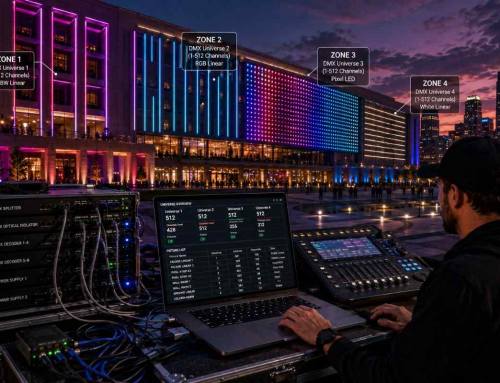
Each DMX universe supports up to 512 channels. As systems grow, multiple universes become necessary. Rather than waiting until capacity becomes a problem, expansion planning should happen during system design, not after.
Professional installations typically include:
- Multi-universe controllers
- Expansion-ready network infrastructure
- Pre-planned gateway locations
- Spare universe allocation
Getting this right at the start makes scaling far less disruptive later.
Modular System Design
Modularity is one of the most practical future-proofing tools available. Instead of treating an installation as one large monolithic system, breaking it into manageable sections, physical zones, fixture groups, and lighting scenes means new elements can be added without touching unrelated parts of the system.
Electrical Design Considerations for Expansion
Control systems get most of the attention, but electrical planning matters just as much when it comes to future-proofing.
Power Supply Headroom
Future expansion needs available power capacity. Undersized power systems are often the first obstacle when additional fixtures show up. A widely used practice is designing with roughly 20 to 30 percent power headroom, flexibility for additional fixtures, increased operating loads, and future upgrades. Power reserves also reduce stress on components during normal operation, which extends their working life.
Distributed Power Architecture
Large installations benefit from distributing power across multiple zones rather than relying on one central supply. The advantages are real: better reliability, easier maintenance, cleaner load management, and simpler expansion. When one area changes, the rest of the system keeps running without disruption.
Planning for Cable Distances
Voltage drop becomes increasingly important as systems expand. Future-proofed designs account for long cable runs, driver placement, and power injection locations from the start. Keeping drivers close to their lighting loads tends to improve efficiency and makes future additions significantly cleaner.
Building a Scalable DMX Communication Network
Expansion is only practical when the communication infrastructure can actually support it.
Maintaining Signal Integrity
Reliable DMX communication depends on solid signal management from the ground up. DMX-rated twisted-pair cable, proper line termination, structured cable routing, and avoiding unnecessary signal degradation are the basics, but they're basics that get skipped more often than they should be. Poor signal design becomes more noticeable, not less, as systems grow.
Using Splitters and Repeaters
As fixture counts increase, signal distribution gets more complex. DMX splitters and repeaters help maintain signal quality across larger installations, stronger signal distribution, better fault isolation, easier troubleshooting, and greater expansion flexibility. In large architectural systems, these aren't optional extras; they're essential components.
Transitioning to Network-Based DMX
Traditional DMX cabling holds up well, but Ethernet-based systems provide a level of scalability that cabling alone can't match. Art-Net and sACN carry multiple universes across standard network infrastructure simultaneously. For any project with realistic growth expectations, network-based DMX provides the most flexible foundation available.
Choosing Future-Ready Controllers and Hardware
Hardware selection often determines whether a system stays adaptable years down the road or becomes a bottleneck.
Scalable Controllers
Controllers should support more than the immediate project requires. Multiple universe support, software update capability, network integration, and external automation compatibility are features worth prioritizing. Controllers with limited expansion options have a way of becoming the ceiling that stops a system from growing when it needs to.
DMX-Compatible LED Drivers
Drivers play a bigger role in system flexibility than most people expect. Professional installations benefit from drivers that support direct DMX control, smooth dimming, flicker-free performance, and consistent communication behavior. Driver replacement shouldn't require redesigning the system around it.
Standards-Based Compatibility
Industry-standard DMX512 compatibility provides long-term advantages that proprietary systems simply can't offer: easier product replacement, greater vendor flexibility, better interoperability, and a longer usable system lifespan. Avoiding proprietary lock-in tends to make future upgrades significantly less painful.
Smart System Design: Scenes, Zones, and Logic
Future-proofing isn't only about hardware. Programming structure shapes how well a system handles change.
Scene-Based Programming
Most commercial environments run on predefined scenes, day mode, night mode, event mode, and maintenance mode. When scenes are built with future flexibility in mind, adding fixtures doesn't mean rewriting everything from scratch.
Zone-Based Architecture
Independent zones give a system real operational flexibility. Ambient lighting zones, retail display zones, architectural accent zones, exterior zones — well-defined zoning means new fixtures can slot into existing control structures without forcing changes elsewhere.
Flexible Logic Design
Rigid programming creates problems during expansion. Future-ready systems use adaptable control logic that can absorb additional fixtures, new scenes, and expanded functionality without requiring a complete overhaul of the control strategy.
Installation Best Practices for Long-Term Expansion
Good documentation is one of the most overlooked parts of building a system that lasts.
Structured Documentation
Professional projects maintain DMX address schedules, universe allocation charts, fixture inventories, and wiring diagrams. Years after installation, these records are often the difference between a straightforward expansion and a full investigation into how the system was originally set up.
Accessibility Matters
When controllers, drivers, and connection points are buried somewhere you no longer have access to them, and it gets very difficult to expand. These design features might include the ability to alter gear within certain accessible junction areas, or serviceable equipment placement and clear pathways left for future wiring runs. Ease of access cuts both the price and intricacy of updates.
Professional Installation Standards
The long-term truthfulness of any system truly depends on the way in which it was initially installed. Grounding, which should be done properly, according to applicable code and taking into account signal isolation where necessary, effective cable routing, all create a solid base for anything else that follows.
Reliability and Performance Optimization
A system designed for expansion also needs to maintain its performance as it grows.
Flicker-Free Operation
Professional-grade drivers and controllers help maintain stable output across changing loads, especially important in hospitality environments, retail spaces, and broadcast applications, where flicker is simply not acceptable.
Redundancy Planning
Critical facilities often benefit from building in redundancy, backup controllers, redundant signal paths, and secondary network infrastructure. Redundancy reduces disruption during maintenance or equipment failure in environments where downtime has real consequences.
Environmental Protection
Long-term performance depends heavily on environmental conditions. Heat management, moisture protection, ventilation, and outdoor exposure all need to be part of the design conversation, not an afterthought once problems start showing up.
Creating an Upgrade Path
The key thing to future-proofing, however, is clearly how the system evolves.
A growing DMX system usually goes through some number of natural stages:
Stage 1: One universe system for core fixtures and basic lighting scenes
Stage 2: New zones are introduced while the central control architecture remains in place.
Stage 3: Have the capacity for an excess universe to help develop apparatus checks and further developed control requirements.
Stage 4: In which the system interacts with a full network environment, providing Art-Net or sACN data and interoperating with legacy and new technologies from the building.
The basic principle is simple: without a total infrastructure rework at every stage, a system should gradually progress through Stage 1 +, Stage 2 +, and Stage 3 to arrive as near as possible to Stage 4.
The Role of Manufacturer Support
Future-proofing doesn't stop at installation. Ongoing support shapes long-term outcomes in real ways.
Good manufacturers contribute through system design guidance, wiring documentation, product consistency over time, technical troubleshooting, and expansion planning assistance. Strong documentation and long-term product availability often make future upgrades far less complicated than they would otherwise be.
Building for What Comes Next
DMX is scalable by nature, but scalability doesn't happen on its own.
Future-proofing takes deliberate planning across power, communication, control, and installation design. Systems built with spare capacity, modular architecture, solid documentation, and expansion-ready infrastructure handle change without falling apart. Those that weren't planned that way tend to need expensive intervention at exactly the wrong moment.
At SIRS-E, scalable lighting design is treated as a long-term system strategy rather than a one-time installation. When power distribution, DMX communication, control architecture, and hardware compatibility are considered together from the start, lighting systems grow alongside changing needs without sacrificing the reliability and performance the installation was built to deliver.
FAQs
How many fixtures can a DMX system support?
Scalability: While one universe can control around 512 channels, multi-universe systems are able to scale up to thousands of fixtures, depending on the capabilities of the controller and network.
Can DMX systems be upgraded without rewiring?
Yes. It is also possible for truly well-designed systems, with modular zones and network-based infrastructure, to expand without too much rewiring needing to take place.
What is the primary limit on DMX expansion?
Almost every expansion problem is simply a result of poor early decisions about channel capacity, power distribution, and signal topology.
Should I use Art-Net or traditional DMX?
For small systems, traditional DMX is fine. If your installation is larger and will be expected to scale up over time, Art-Net and sACN will offer you more flexibility.
How important is documentation?
Critical. To track down problems and make modifications in the future, both documentation and accurate records are necessary during installation.









Leave A Comment
You must be logged in to post a comment.