

What Is the ROI of Professional-Grade LED Lighting Over 5–10 Years?
Most people treat lighting like a purchase. Pick a fixture, approve a budget, and get it installed.
That thinking works fine for a lamp at home. For a commercial building, it misses most of the financial picture.
Lighting in a commercial space works more like a utility than a product. It runs every day, shapes how the building operates, and drives costs, or savings, for years after the invoice is paid. The financial story doesn't end at installation. It's just getting started.
That's why the businesses that come out ahead on lighting decisions tend to think in terms of ROI rather than sticker price.
- What does this system actually cost to run?
- What does it save?
- What problems does it prevent?
Answered honestly, those questions tell a very different story than the upfront quote.
Professional-grade LED systems are built around long-term performance, lower running costs, less maintenance, better reliability, longer service life, and smarter control. Over five to ten years, those qualities translate into real financial returns that budget systems simply don't deliver.
What ROI Actually Covers
Energy savings get most of the attention in lighting ROI conversations. Understandably, they're easy to calculate and show up on every utility bill.
But energy is only part of what drives the numbers.
A complete picture includes:
- What does the system cost to install
- What it costs to run month to month
- How much maintenance does it need
- How often do components need replacing
- How much downtime does it cause when things go wrong
- How much the control setup saves through smarter operation
All of these feed into the total financial outcome. Focus on just one, and the math gets misleading fast.
ROI and Payback Aren't the Same Thing
Payback tells you when you've recovered what you spent. ROI tells you what the system has actually delivered over its whole life.
A project can hit payback in three years and keep producing returns for seven more. Payback is a milestone. ROI is the full story. For commercial lighting decisions, the full story is what matters.
Where Traditional Lighting Loses Ground
The financial gap between traditional lighting and LED systems becomes obvious pretty quickly when you look at what actually drives costs over time.
In U.S. commercial buildings, lighting accounts for approximately 10% of total building energy consumption, making it one of the largest energy end uses.
Energy
Traditional lighting wastes a significant portion of its energy output as heat. LED systems don't. Higher efficiency, better directional output, and less energy consumed for the same amount of light. Those savings start accumulating from the first day the system runs.
Maintenance
Lamps burn out. Ballasts fail. Somebody has to deal with it, scheduling the work, arranging access, paying for labor and parts, and managing the disruption in between. In environments where getting to a fixture means scaffolding, lift equipment, or closing off a section of the building, those costs add up fast.
LED systems stretch service intervals significantly. Fewer replacements, less labor, fewer disruptions. In a lot of commercial environments, this ends up being the biggest financial win, bigger even than energy savings.
Controls
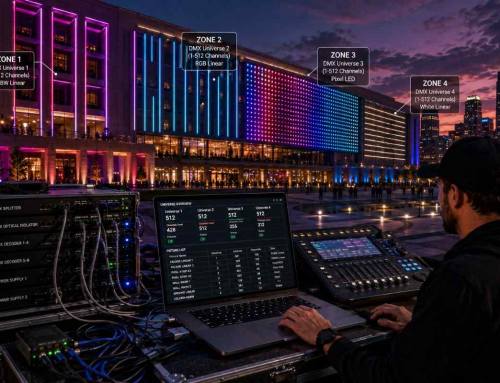
Traditional lighting mostly runs at full output whether the space needs it or not. DMX-controlled LED systems actually respond to conditions, schedules, zones, occupancy, and events. That flexibility cuts unnecessary energy use without making the space any less functional.
The First Five Years: Where ROI Begins
The first phase of ROI kicks in almost immediately after installation. Operational savings start accumulating from the first billing cycle.
Energy Savings
Reduced power consumption is the largest early financial benefit. Facilities running lighting for extended hours, retail stores, hotels, restaurants, offices, and entertainment venues often see measurable savings within the first year. The more hours the system runs, the faster those savings add up.
Maintenance Reduction
With fewer lamp replacements and longer service intervals, facility teams spend less time chasing lighting issues. That means savings in both labor and operational resources, especially noticeable in environments where getting to a fixture is disruptive or time-consuming.
Operational Efficiency
Automation adds value here. Lighting scenes run on schedules. Zones operate independently. Adjustments happen automatically instead of manually. These improvements don't always show up directly on an energy bill, but they reduce the operational friction that quietly costs facilities money over time.
The Ten-Year Perspective: Where Value Compounds
The financial advantages of professional-grade LED systems become most apparent over the long haul. Many of the biggest benefits arrive after the initial payback period has already been cleared.
Total Energy Cost Reduction
Energy savings don't stop once payback is achieved. They keep stacking year after year. Over ten years, cumulative energy savings often represent a substantial share of total ROI, and that number keeps growing as long as the system runs efficiently.
Lifecycle Replacement Avoidance
One of the most underappreciated financial advantages is simply avoiding repeated replacement cycles.
Professional-grade LED systems are commonly rated for 50,000, 75,000, or even 100,000 hours of operation. Depending on usage, that can eliminate multiple replacement events that would otherwise happen regularly with traditional technologies, cutting both direct costs and the indirect costs that come with every replacement cycle.
Infrastructure Stability
Lighting systems don't exist in isolation. They connect to drivers, controls, power distribution, and building infrastructure. Stable systems need fewer redesigns, fewer retrofits, and fewer emergency fixes. That stability has real financial value, even when it's hard to put a precise number on it.
Why Professional-Grade Systems Deliver Stronger ROI
Not every LED system produces the same financial outcome. Quality shapes both performance and lifecycle costs in ways that show up clearly over time.
Professional-grade systems carry a higher upfront cost because they include better components, certified products, stronger thermal management, advanced control capabilities, and integration support. That gap narrows quickly when the comparison stretches across the full system lifespan.
In commercial environments, consistent operation matters beyond just maintenance expenses. Lighting failures affect customer experience, brand presentation, operational efficiency, and safety. Fewer failures protect both revenue and day-to-day continuity.
In DMX-based environments, system-level efficiency adds another layer: better power distribution, more reliable dimming, cleaner communication, and tighter zone coordination. These efficiencies build long-term operational value that fixture specs alone don't capture.
How Control Systems Influence ROI
Some of the most meaningful ROI improvements come from control strategy rather than fixture technology alone.
DMX systems give facilities centralized control over multiple lighting zones, letting them reduce unnecessary loads without sacrificing visual performance where it actually matters. Instead of running everything at full output all the time, lighting responds to what's actually happening in the space.
Different areas of a building rarely need identical lighting conditions. Independent zone control means occupied areas stay well-lit while unused spaces dial back automatically. Schedules, occupancy triggers, event-based scenes, and daylight-responsive adjustments all chip away at wasted operating hours, and those hours add up significantly over ten years.
What Influences ROI Variability?
No two installations hit identical ROI numbers. Results vary based on:
- Installation quality
- Daily operating hours
- Environmental conditions
- Maintenance practices
- Control strategy
A facility running 24/7 reaches payback faster than one operating a few hours a day. A system with optimized DMX programming typically outperforms one running at fixed output levels. The variables matter, and they're worth thinking through before the project starts.
Looking Ahead: Future ROI Drivers
Lighting technology keeps moving forward. Future ROI improvements are already taking shape through AI-assisted control, IoT-connected building systems, predictive maintenance analytics, hybrid DMX and networked control environments, and energy-price-aware automation. These developments push the value of lighting well beyond basic illumination.
Built for Long-Term Value
The ROI of professional-grade LED lighting doesn't live in the purchase price. It lives in what happens after the system starts running.
Lower energy bills, fewer maintenance calls, avoided replacement cycles, reliable operation, smarter control, these advantages build on each other over five to ten years in ways that a budget system simply can't match.
For facilities that depend on consistent, high-quality lighting every day, the financial case for investing in a professionally designed system isn't complicated. The numbers tend to make the argument on their own.
If you're evaluating LED lighting solutions for a commercial, architectural, or DMX-controlled project, SIRS-E supports designers, integrators, contractors, and facility teams with engineered lighting solutions, DMX-compatible control systems, and technical guidance focused on long-term performance.
Frequently Asked Question's
How long is the Return On Investment for LED lights?
Payback is rapid– on average, this is achieved in two to five years, depending on operating hours and system size, and energy costs.
What are the biggest areas driving return on investments with LED lighting?
Often, across the lifecycle, most of the savings come from energy and less maintenance required.
Do DMX systems improve ROI?
Yes. The DMX system provides the capabilities described above to minimize or eliminate inefficient energy use while maximizing operational flexibility.
So why are professional LEDs more expensive in the short term?
A professional setup is created using better parts and products backed by factory testing to have greater control functions for long-lasting dependability in industrial scenarios.
Is LED still financially viable for project consideration?
Yes. While in a commercial environment, the ROI is significantly more than that, even in a small setting, reduced consumption and less servicing potential mean an appreciable financial impact as well.








Leave A Comment
You must be logged in to post a comment.