

How Do Multi-Universe DMX Systems Work?
DMX has been a lighting control staple for decades.
Walk into almost any architectural, entertainment, or commercial lighting environment, and you'll find it running somewhere in the background. The protocol holds up because it's reliable, straightforward, and works with practically everything.
Its continued dominance is reflected in the market as well. According to industry market research, DMX-based control systems accounted for approximately 67.3% of global stage-lighting control revenue in 2025, reinforcing their position as the primary control technology across professional lighting installations worldwide.
But a single DMX universe has a ceiling.
512 channels. That's the hard limit. For a small installation, a handful of fixtures, basic dimming, simple scene control, and 512 channels is more than enough. Nobody runs into that wall on a small job.
The problem shows up on bigger projects.
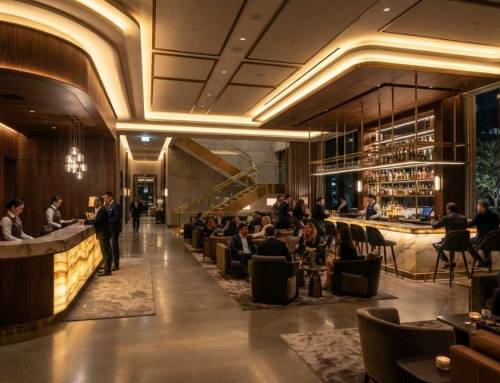
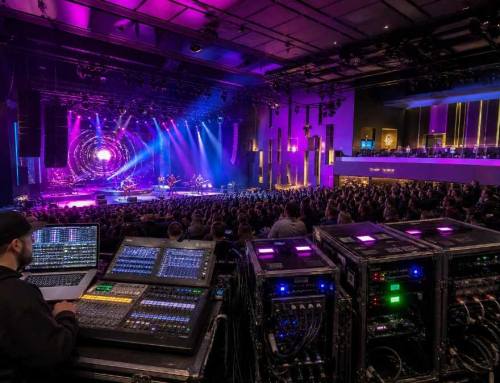
An architectural facade with hundreds of individually addressed fixtures. An entertainment venue running moving lights, pixel strips, and dynamic color effects simultaneously. A commercial building where every zone needs independent intelligent control. In these environments, 512 channels can disappear before the design is even finished.
Adding more universes is how the industry solved that problem.
Instead of forcing everything through one control stream, fixtures get distributed across multiple independent universes. The system grows without losing organization, signal reliability, or control flexibility. That's the whole idea behind multi-universe DMX, not complexity for its own sake, but room to grow without starting over.
Understanding the DMX Universe Concept
Worth stepping back for a moment before getting into how multi-universe systems work.
What a Universe Represents
A DMX universe is one continuous stream of control data. It carries 512 channels, each holding a value between 0 and 255. Fixtures read those values and respond accordingly.
How many channels a fixture uses depends entirely on what it does:
- A basic dimmer might need just one channel
- A color-changing fixture typically uses three to five
- A moving light with effects and pixel control can burn through thirty or forty channels on its own
The more a fixture can do, the more channels it needs. In a system with dozens of complex fixtures, 512 channels get tight fast.
Why Universes Are Independent
Each universe runs completely on its own. Universe 1 has no idea what Universe 2 is doing. They don't share data, and they don't interfere with each other.
Channel numbering also starts fresh in every universe:
- Universe 1 contains channels 1–512
- Universe 2 contains channels 1–512
- Universe 3 contains channels 1–512
That independence is exactly what makes expansion possible without things getting tangled.
What "Multi-Universe" Actually Means
The concept is simpler than it sounds.
Expanding Beyond 512 Channels
Hit the capacity of one universe, add another. Each new universe is an extra lane. Fixtures that don't fit in Universe 1 go into Universe 2. When Universe 2 fills up, Universe 3 gets added. The system keeps growing without any single universe getting overloaded.
A Practical Example
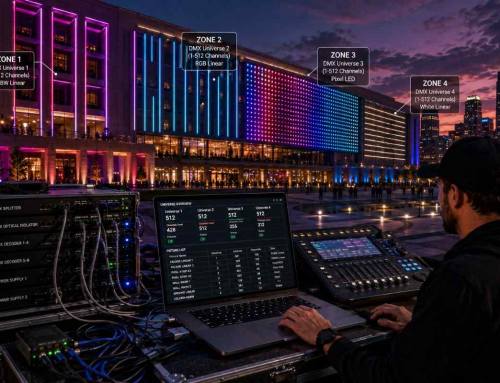
In practice, installers usually divide universes by function rather than just filling them sequentially. A real installation might look like this:
- Universe 1 → General ambient lighting
- Universe 2 → Architectural accent fixtures
- Universe 3 → Exterior facade
- Universe 4 → Dynamic RGB feature lighting
From the operator's side, everything feels like one system. Scenes run across zones, schedules fire automatically, and everything moves together. Under the hood, four separate universes run in parallel, each handling its own fixtures independently.
System Architecture in Multi-Universe Design
Large multi-universe systems follow a layered structure where each layer handles a specific job.
DMX Controller Layer
The controller sits at the top. It might be a dedicated lighting console, a software platform, or a standalone architectural controller. Whatever form it takes, the controller generates all universes simultaneously, handling scene creation, scheduling, fixture mapping, universe allocation, and address assignment. It decides what data goes out in each universe.
Distribution Layer
Below the controller is the distribution layer. The controller's output has to reach fixtures spread across a building, campus, or facade. That distribution happens through physical DMX cable runs or, far more commonly in large systems today, through an Ethernet-based network.
Fixture Layer
At the edges of the system are the fixtures and drivers. Each one is assigned to a specific universe and given a start address. It listens only to what's addressed to it and ignores everything else, which is what keeps a system with hundreds of fixtures from becoming complete chaos.
Two Main Ways Multi-Universe Systems Are Delivered
Not every multi-universe system is built the same way. The method depends on project size and infrastructure.
Physical DMX Output Expansion
The traditional approach runs a separate cable for each universe. One physical output on the controller equals one universe. It works fine on smaller jobs where everything sits relatively close together. Scale it up, and cable management becomes a genuine problem, dozens of individual DMX runs snaking through walls and ceilings across a large facility.
Network-Based DMX Distribution
Network-based distribution is how most large systems handle it today. Art-Net and sACN are the two protocols that dominate. Both carry multiple universes across standard Ethernet infrastructure simultaneously. One network cable handles far more universes than any practical installation would ever need.
DMX nodes handle conversion at the other end. A node sits near a fixture group, receives the network data, and outputs standard DMX signals locally. Instead of running a DMX cable from the controller room all the way to a fixture on the far side of a building, a network cable goes to a nearby node, and short DMX runs handle the last stretch. It changes the entire scale of what's manageable.
Addressing in Multi-Universe Systems
Addressing discipline is what separates a system that's easy to work on from one that becomes a troubleshooting nightmare.
Fixture Address Structure
Every fixture needs two things: a universe number and a start address. Those two pieces of information define exactly where the fixture receives its control data.
Example Mapping
A straightforward allocation might look like:
- Fixture A → Universe 1, Address 1–10
- Fixture B → Universe 1, Address 11–30
- Fixture C → Universe 2, Address 1–20
Fixture C starts at Address 1 just like Fixture A, but there's no conflict because they live in different universes. Addresses only need to be unique within each universe, not across the whole system.
Why Address Planning Matters
Good address planning pays off when something goes wrong. A technician who can pull up a clean universe map and find exactly which fixtures live where can isolate a problem in minutes. Without that structure, the same job can take hours. Poor address planning is one of those decisions that feels harmless at installation and painful every time after.
The Role of DMX Nodes
On larger projects, DMX nodes become one of the most important components in the whole system.
What a DMX Node Does
A node acts as a translator. It receives network data from Art-Net or sACN and converts it into standard DMX outputs that fixtures can actually read.
Why Nodes Matter
Without nodes, large projects would need extensive direct cabling running from the controller to every fixture location across the building. Nodes bring DMX distribution closer to where fixtures actually are, with less cable complexity, better scalability, simpler installation, and cleaner signal management. They're often the piece that makes a large system genuinely workable in the field.
Scalability in Professional Installations
Scalability is the whole reason multi-universe design exists, and professional installations are built with that in mind from the start.
Architectural Lighting Systems
Architectural installations typically divide universes by area:
- Lobby lighting → Universe 1
- Corridor lighting → Universe 2
- Conference spaces → Universe 3
- Exterior facade → Universe 4
That separation keeps both control and maintenance clean as the system grows.
LED Driver Integration
DMX-compatible drivers receive universe-specific commands and translate them into fixture behavior. Distributed systems stay coordinated across multiple locations without stepping on each other.
Designing for Expansion
Professional systems are rarely designed just for today. Spare universe capacity, growth allowances, future fixture allocation, and structured zoning get built in from the start. That planning avoids costly redesigns when requirements inevitably change.
Key Design Considerations
Channel Planning
Estimating channel usage early is one of the first things any large system design should tackle. Leaving spare capacity within each universe creates room to grow. A universe packed to capacity on day one leaves nowhere to go when things change.
Network Infrastructure
In Ethernet-based systems, every additional universe adds network traffic. Reliable switches, proper configuration, and organized infrastructure matter more as scale increases — not less.
Signal Integrity
Scale doesn't change the fundamentals. Proper termination, quality cabling, clean signal paths, and structured segmentation matter just as much in a large system as they do in a small one.
Documentation
On any multi-universe installation, documentation is one of the most valuable things the project produces. Universe maps, address schedules, wiring diagrams, and fixture allocation records become critical during maintenance, troubleshooting, and future expansion. Skipping this step is a decision that tends to hurt later.
Built for Scale
Multi-universe DMX systems are the foundation of modern professional lighting design.
They allow lighting environments to grow well beyond the 512-channel ceiling of a single universe while keeping organization and reliability intact, whether the application is architectural lighting, a commercial facility, an entertainment venue, or a complex LED installation.
At SIRS-E, multi-universe design is about more than adding channels. It's about organizing power, control, and communication so lighting systems stay reliable, maintainable, and ready for whatever comes next. When universes are planned carefully and built into a structured architecture, the result is a system that keeps performing long after the installation is done.
Frequently Asked Question's
What exactly is a DMX universe?
A DMX universe is a single stream of DMX data containing up to 512 control channels used to send instructions to lighting fixtures and control devices.
How many universes can a DMX system support?
Modern systems don't have a fixed practical limit. The total depends on controller capabilities, network architecture, and protocols like Art-Net or sACN. Large installations regularly run dozens or hundreds of universes.
Do multiple universes require separate cables?
Not always. Traditional DMX systems need separate outputs and cabling per universe. Network-based systems carry multiple universes over a shared Ethernet infrastructure instead.
Can fixtures work across multiple universes?
Most fixtures operate within a single universe. Advanced pixel-based systems and media control platforms can combine data from multiple universes through software or controller mapping.
What is the main reason to use multiple universes?
Scalability. Multi-universe systems let lighting projects grow beyond the 512-channel limit of a single DMX universe while keeping control structured and operation reliable.









Leave A Comment
You must be logged in to post a comment.