
How Human-Centric Lighting Improves Healthcare Spaces
Light affects sleep, stress, and focus. When it never changes, patients don’t rest well and staff feel worn out. Human-centric lighting lets light change through the day. Brighter and cooler when people need to be alert. Softer and warmer when it’s time to slow down. That alone helps spaces feel calmer and more natural.
It only works if the system is done properly.
That’s the kind of lighting SIRS-E builds and supports.
Human Centric Lighting in healthcare is usually treated as infrastructure. It meets code, lights the room and then everyone moves on.
But once a facility is in use, the limitations show up fast. Patients struggle to sleep under constant light. Staff feel visual fatigue during long shifts. Spaces feel flat and disorienting, especially at night.
We see this firsthand. At SIRS-E, we work with healthcare lighting systems every day. The difference between lighting that simply meets requirements and lighting that’s designed around people is immediate.
Human-centric lighting makes that difference visible. It changes how patients rest, how staff work, and how healthcare spaces function over a full 24-hour cycle.
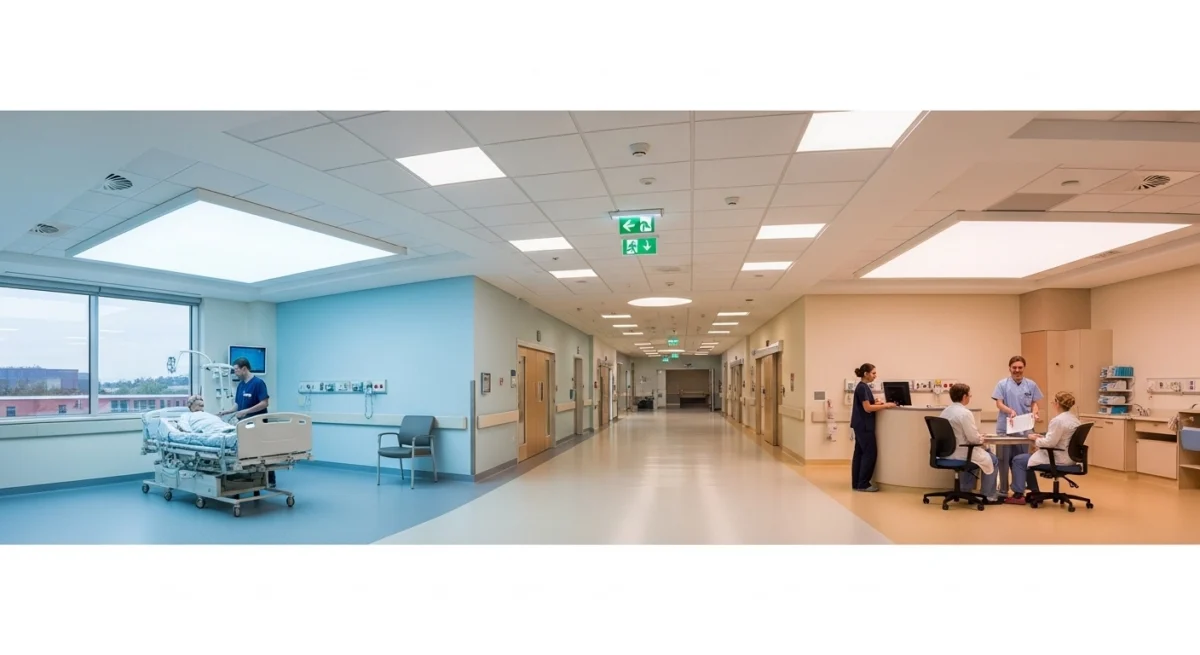
Why Lighting Matters in Healthcare
Hospitals and clinics don’t follow a normal schedule. Patients may stay inside for days. Sometimes weeks. Staff rotate through shifts at all hours. Natural daylight is often limited or inconsistent. That matters because the human body depends on light to stay regulated.
Our circadian rhythm acts like an internal clock. It controls sleep, alertness, hormone production, and mood. Light is the main signal that keeps that clock on track. When lighting stays the same all day and night, the body loses its cues, sleep becomes fragmented and stress builds.
Research in healthcare settings has shown that appropriate light exposure can improve sleep and circadian alignment. It has also been linked to reduced depression, lower agitation in dementia patients, and, in some cases, shorter hospital stays.
Daylight plays a role too. Patients with access to natural light often report less stress and pain. Many require fewer pain medications compared to patients without daylight exposure.
What Human-Centric Lighting (HCL) Means in Healthcare
Human-centric lighting starts with a basic truth: The body pays attention to light, whether we want it to or not. Daylight changes, morning feels different from evening and night feels different from both. Most indoor lighting ignores that. It stays flat, all day and night.
HCL doesn’t.
- During the day, light is brighter and cooler. It helps people stay awake, oriented, and mentally present.
- As the day ends, light softens. It warms. The environment slows down.
That shift matters because light affects hormones. Cooler light supports alertness. Warmer light allows the body to move toward rest and sleep. In healthcare spaces, those signals are often missing. Patients stay indoors for long stretches. Staff work through nights under lighting that never changes.
Human-centric lighting brings back a sense of time. Day feels like day. Night feels like night.
Core Benefits of Human Centric Lightning in Healthcare Environments
Sleep and Recovery
Sleep plays a critical role in healing, and it cannot be overlooked. Therefore, lighting that reinforces natural day and night cues helps patients rest more effectively. During the day, brighter light supports alertness, while at night, minimal and warmer lighting encourages relaxation. As a result, consistent sleep patterns improve overall comfort and recovery, especially in inpatient and long-term care environments.
Stress and Emotional Comfort
Lighting influences mood more quickly than many people realize. For instance, harsh lighting can increase anxiety, whereas flat lighting may feel disorienting. This effect becomes even more noticeable in dementia care and behavioral health settings.
However, human-centric lighting creates a calmer environment by reducing visual strain and supporting a clearer sense of time. Consequently, many patients experience improved daily comfort and reduced stress levels.
Staff Alertness and Focus
Healthcare staff require lighting that supports their work rather than working against them. Therefore, lighting systems that follow natural rhythms help maintain alertness during the day and reduce strain at night.
In addition, better lighting conditions lead to fewer headaches, reduced eye fatigue, and improved focus during detailed tasks. Over long shifts, these benefits become even more important for overall efficiency and well-being.
Visual Accuracy and Safety
Effective lighting improves visibility and enhances accuracy in critical environments. For example, LED systems with proper color rendering and uniform distribution reduce glare and eye strain. As a result, staff can read charts, monitor equipment, and assess patient conditions more accurately.
Consequently, improved visual clarity directly contributes to better patient safety and care outcomes.
Energy Use and Efficiency
Human-centric lighting systems are typically LED-based, which naturally improves energy efficiency. Moreover, with advanced controls, lighting levels adjust automatically based on needs and conditions.
As a result, energy consumption decreases while maintaining consistent lighting quality. Therefore, facilities benefit from both operational savings and reliable performance.
Real Use Cases in Healthcare
Patient Rooms
Patient rooms experience the most direct impact of human-centric lighting, as daytime lighting supports alertness and orientation while nighttime lighting remains warm and subdued. As a result, patients can rest without unnecessary disruption.
Moreover, this balance creates a calmer environment, and the overall rhythm of the space feels more natural and supportive of recovery.
Staff Areas
Nurses’ stations and support spaces benefit from lighting that maintains focus without overstimulation. In addition, human-centric lighting helps staff stay alert during critical tasks while avoiding excessive brightness during night shifts.
Therefore, this balanced approach reduces fatigue over time and supports better working conditions.
Intensive and Special Care Units
In ICUs and recovery units, access to natural daylight is often limited. Therefore, human-centric lighting plays a crucial role in maintaining circadian cues within these environments.
As a result, it supports patient orientation and reduces confusion, especially after surgery or sedation.
Behavioral Health Environments
Behavioral health settings require carefully planned lighting strategies due to strict safety requirements. However, comfort remains equally important in these environments.
Therefore, human-centric lighting, when combined with appropriate fixtures and controls, effectively supports both safety and patient well-being.
How LEDs and Controls Enable HCL
Traditional lighting cannot deliver this level of control effectively; however, LED systems can. In addition, LEDs provide precise control over brightness and color temperature while responding quickly to changes. Moreover, these systems integrate seamlessly with modern control platforms and remain stable when designed correctly.
Key capabilities include:
- Smooth tuning of color temperature
- Wide dimming ranges
- Compatibility with DMX and advanced controls
- High refresh rates to prevent flicker
At SIRS-E, we engineer UL-certified LED strips, drivers, and control-ready solutions for professional environments. In healthcare, consistency and safety are critical; therefore, proper drivers, accurate power planning, and certified components play a key role.
Furthermore, installation quality is equally important. Licensed electricians, compliant wiring, and thoroughly tested hardware support reliable performance. As a result, lighting systems in clinical environments operate consistently without unexpected issues.
Challenges to Get Right in Healthcare Lighting
Human-centric lighting sounds straightforward. In practice, it isn’t. Healthcare spaces come with constraints that don’t exist in other buildings.
Daylight Is Uneven and Unpredictable
Daylight helps, but it doesn’t behave.
Some rooms get plenty of it. Others get almost none. Sun angles change. Glare shows up where it shouldn’t. What works at noon may not work in the afternoon.
Electric lighting has to respond to those shifts. It needs to support daylight, not overpower it or clash with it. When that balance is off, people feel it immediately.
One Building, Many Use Cases
Healthcare lighting is never uniform.
- Patient rooms need quiet control.
- Clinical areas need clarity and consistency.
- Public spaces need comfort and orientation.
The mistake is treating all of it the same. Human-centric lighting only works when each zone is handled on its own terms. One preset won’t serve everyone.
Control Systems Can Make or Break It
Adjustable lighting only helps if it behaves properly.
Poor controls introduce flicker. Transitions feel abrupt. Light levels don’t land where they should. In healthcare spaces, that quickly becomes a problem. Stable drivers, proper refresh rates, and compatible controls matter a lot. If the system isn’t solid, people stop trusting it.
Details Decide the Outcome
Human-centric lighting depends on fundamentals.
- Power planning has to be right.
- Drivers have to match the load.
- Components must be certified.
- Installation must be professional.
When those pieces are handled correctly, lighting fades into the background. When they’re not, issues show up fast.
That’s why we take a conservative approach at SIRS-E. We focus on certified hardware, clear documentation, and practical guidance. In healthcare environments, lighting has to work the same way every day.
Better Lighting Supports Better Care
Human-centric lighting isn’t complicated. It just respects how people actually respond to light. When lighting follows a natural rhythm, patients sleep more easily. Staff feel less strain. Spaces feel calmer without trying too hard.
That only works if the system is built properly. The right LEDs. The right drivers. Controls that behave the way they should without flicker and shortcuts.
At SIRS-E, that’s how we approach every project. We build UL-certified LED lighting and control-ready systems for environments where reliability matters and mistakes aren’t an option.
If you’re planning human-centric lighting in a healthcare setting, take a look at our products or reach out to our support team. We’ll help you think it through before anything gets installed.
Frequently Asked Questions:-
What is human-centric lighting in healthcare?
It’s lighting that adjusts intensity and color throughout the day to support natural circadian rhythms.
How does it help patient recovery?
By supporting better sleep and reducing stress, it creates more favorable recovery conditions.
Does lighting affect staff performance?
Yes. Lighting aligned with natural rhythms can support alertness and reduce fatigue during long shifts.
Is special equipment required?
Yes. Tunable LED fixtures, proper drivers, and compatible control systems are required. UL certification matters.
How does SIRS-E support these projects?
We provide UL-certified products, engineered drivers, control compatibility, wiring diagrams, and technical support focused on safe implementation.








Leave A Comment
You must be logged in to post a comment.