
What Determines the Quality of Professional LED Strip Lights
LED strip lights show up everywhere in professional projects. Offices. Retail spaces. Architectural details. Industrial builds. On paper, many of them look the same. Same voltages. Similar brightness numbers. Similar reels and connectors.
That similarity only holds at installation.
The differences surface later. Sections that dim unevenly. Color that no longer matches from one run to the next. Systems that run hotter than expected. Power supplies that start working harder just to keep output stable. These are not instant failures. They are slow ones.
The U.S. Department of Energy notes that LED lighting can last far longer than traditional sources, but only when heat, power, and operating conditions are controlled. When they are not, lifespan claims collapse quickly, even if efficiency numbers looked good at purchase.
That is why evaluating LED strip quality requires more than scanning a spec sheet. It requires understanding the engineering decisions that determine how the system behaves after months of use.
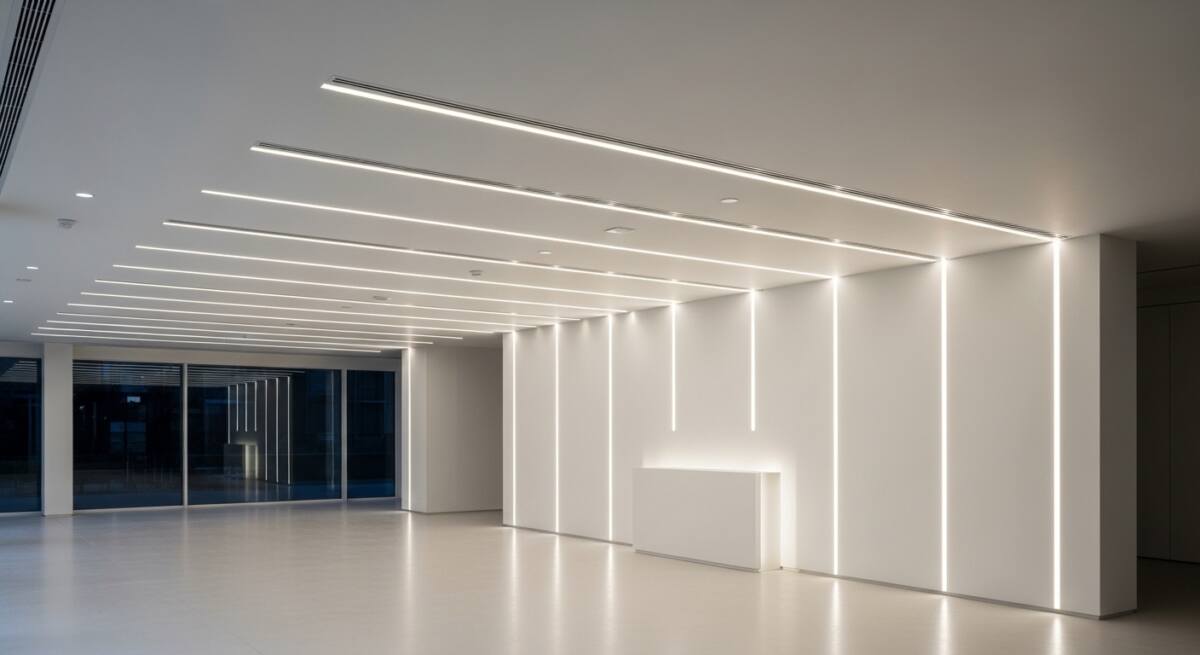
Why LED Strip Quality Matters in Professional Installations
In professional environments, LED strips are not decorative accessories. They are part of a permanent electrical system.
These installations often involve:
- Daily operation exceeding 10 hours
- Long, continuous runs
- Enclosed or concealed mounting locations
- Limited access after installation
When quality is insufficient, failures are rarely immediate. Instead, problems develop gradually. Brightness drops unevenly. Color shifts become visible. Flicker appears under load. In worst cases, overheating stresses electrical components.
The U.S. Consumer Product Safety Commission consistently identifies electrical distribution failures and overheating as contributing factors in building fire incidents. This is why certified electrical components matter in permanent lighting systems.
In professional settings, the cost of failure is not just the product. It includes labor, downtime, and safety risk.
What “Quality” Actually Means in LED Strip Lighting
Quality in LED strip lighting is not a feature or a claim. It is a set of behaviors that remain stable over time.
A professional-grade LED strip demonstrates:
- Predictable electrical behavior under continuous load
- Controlled operating temperature
- Consistent color and brightness across the entire run
- Repeatable performance across production batches
- Compliance with recognized safety standards
Quality is proven after thousands of operating hours, not at initial power-on.
LED Components That Define Long-Term Performance
The performance of an LED strip depends primarily on its components and how they are controlled. Therefore, selecting the right combination of elements is essential for long-term reliability and consistency.
LED emitters and binning
LED emitters naturally vary in color temperature, brightness, and electrical behavior. To manage this variation, manufacturers use binning to group LEDs with similar characteristics. However, without strict bin control, visible color differences can appear along a run or between replacement batches.
As a result, these inconsistencies become especially noticeable in architectural applications, where uniformity is critical.
Brightness measured correctly
Brightness should be specified in lumens per foot or meter rather than watts. In fact, the Illuminating Engineering Society recommends lumens as the correct metric because efficiency varies across LED designs.
Moreover, relying only on wattage or missing lumen data can lead to poor performance. Consequently, overdriving LEDs to achieve brightness often reduces lifespan and long-term reliability.
Density, spacing, and uniformity
The density of LEDs directly influences visual smoothness, power demand, and heat buildup. While higher density can improve uniformity, it also increases thermal stress. Therefore, proper balance becomes necessary.
In addition, density must align with diffusion, power delivery, and operating conditions to maintain consistent performance without overheating or inefficiency.
Color quality (CRI and R9)
Color Rendering Index (CRI) determines how accurately colors appear under light. For example, CRI 80 works for many commercial environments, whereas CRI 90+ with strong R9 values is preferred when material appearance, skin tones, or finishes matter.
As a result, achieving higher color fidelity requires better emitter control and higher-quality materials. Therefore, selecting appropriate specifications plays a key role in overall lighting quality.
Table: Component Choices and Their Real-World Impact
| Design Choice | When Poorly Executed | Professional Outcome |
|---|---|---|
| Loose LED binning | Visible color shift | Uniform appearance |
| Watt-only brightness claims | Overdriven LEDs | Stable lumen output |
| Excessive LED density | Heat buildup | Balanced performance |
| Low CRI emitters | Distorted colors | Accurate rendering |
Heat and Power: Where Most LED Strip Systems Fail
Heat is the primary factor that limits LED lifespan. Elevated operating temperatures accelerate lumen depreciation and material degradation.
The U.S. Department of Energy has shown that even moderate temperature increases significantly reduce LED lifetime expectations.
Thermal stress is closely tied to power design. Undersized power supplies, excessive run lengths, and poor distribution create voltage instability and heat concentration.
Table: Common Design Mistakes and Their Consequences
| Design Issue | Long-Term Effect |
|---|---|
| Undersized power supply | Flicker, early failure |
| Single-end power on long runs | Uneven brightness |
| Poor PCB copper weight | Overheating |
| Overdriven LEDs | Rapid lumen loss |
Professional systems plan power delivery intentionally, with proper headroom and distribution.
Circuit Board Design and Manufacturing Discipline
PCB Copper Weight and Current Handling
Electrical current must travel across the full length of the strip, so copper thickness plays a critical role. When copper is too thin, resistance increases, which in turn generates excess heat. Although this may not be noticeable on short runs, longer runs often show dimming, rising temperatures, and unstable output.
Therefore, using heavier copper helps maintain consistent current flow and reduces stress on the strip during extended operation.
Voltage Stability Across Long Runs
Voltage drop is inevitable; however, its severity depends on PCB design quality. Weak board design tends to exaggerate this effect, causing the far end of the run to lag. While initial installation may appear acceptable, these differences often become more visible over time.
As a result, a well-designed board minimizes drift and maintains more uniform output across the entire run.
Manufacturing Repeatability Across Batches
Matching specifications alone does not guarantee consistent performance. Small variations in sourcing, assembly, or handling can accumulate over time and affect results. Without proper controls, batches may drift, leading to color shifts and output inconsistencies.
Consequently, repeatable manufacturing processes ensure that new sections remain compatible with existing installations.
Safety, Certification, and Why UL Matters
Electrical Safety Under Continuous Load
Lighting systems in these environments operate for extended periods rather than brief cycles. Therefore, safety testing evaluates how components perform under sustained electrical load, heat, and fault conditions.
As a result, passing a simple power-on test is not sufficient to guarantee long-term safety.
Thermal Behavior and Fire Risk
Heat-related issues often develop gradually, making them difficult to detect early. For example, materials can degrade, insulation may harden, and adhesives can fail over time.
However, certification testing is designed to identify systems that cannot manage heat effectively before they are installed in permanent environments.
Compliance and Liability in Permanent Installations
Uncertified components increase both risk and liability in permanent lighting systems. In contrast, certification verifies compliance at the product level and cannot be replaced by adjustments during installation.
Therefore, selecting certified components is essential for safety, reliability, and regulatory compliance.
Why Documentation and Technical Support Are Part of Product Quality
Wiring Accuracy and Power Configuration
Many LED strip failures result from incorrect wiring or power configuration rather than product defects. Therefore, clear documentation reduces guesswork and helps prevent errors that could shorten lifespan or create unsafe conditions.
As a result, proper guidance directly improves installation quality and system reliability.
Diagrams and Post-Install Support
Accurate diagrams help ensure that systems are installed correctly from the start. In addition, ongoing technical support becomes valuable when installations are modified, expanded, or adjusted over time.
Consequently, strong documentation and support contribute to long-term performance and adaptability.
How SIRS-E Approaches Professional LED Strip Quality
Most decisions at SIRS-E happen before a product reaches production. Rather than focusing only on how a strip looks at installation, the emphasis remains on how it performs after months of real-world use.
In-House Design and Validation
LED strips are designed and evaluated internally to maintain full control over quality. In addition, electrical load, voltage behavior, and thermal performance are tested under conditions that reflect long runs and continuous operation.
As a result, potential stress points are identified early, allowing issues to be addressed before the product reaches the field.
UL-Driven Development and Controlled Manufacturing
Safety requirements are treated as core design inputs rather than final checkpoints. Therefore, UL standards influence layout, spacing, materials, and performance margins from the beginning.
Moreover, manufacturing processes remain tightly controlled to prevent variation between batches. Consequently, this consistency becomes especially important when systems are expanded, repaired, or matched over time.
How to Evaluate LED Strip Quality With Confidence
Verified Performance Data
Reliable products clearly state lumen output, electrical ratings, and operating limits. However, when this information is incomplete or unclear, evaluating whether the strip operates within safe boundaries becomes difficult.
Therefore, transparent and detailed data plays a critical role in product selection.
Thermal and Power Design Signals
Balanced power density, appropriate LED spacing, and a PCB designed for efficient current flow indicate a system built for long-term use. In contrast, designs focused only on short-term output often overlook thermal management and durability.
As a result, these design signals help identify products intended for sustained performance.
Certification and Support Indicators
Recognized safety certifications confirm that products have been tested under electrical and thermal stress conditions. In addition, accessible documentation and reliable technical support demonstrate accountability beyond the initial purchase.
Consequently, these factors indicate a higher level of product quality and long-term reliability.
Built to Perform After Installation
Professional LED strip quality comes down to practical design decisions. How the strip handles power. How it manages heat. How consistent it stays across long runs and over time. These are things that only become clear once the system has been in use, not on day one.
When those fundamentals are handled correctly, LED strips perform predictably. Light stays even. Color stays aligned. Systems are easier to install, expand, and maintain. That reliability is what defines quality in real projects.
If you’re evaluating LED strip solutions for a professional installation and want help selecting products designed for long-term performance, SIRS-E supports engineers, specifiers, and integrators with UL-certified, U.S.-designed LED strips, clear documentation, and knowledgeable technical support. The goal is simple: lighting systems that keep working the way they were intended to.
Frequently Asked Questions:
Why do some LED strips fail earlier than expected?
Excess heat, overdriven LEDs, poor power delivery, and inadequate thermal design accelerate failure.
Is higher LED density always better?
No. Higher density increases heat and power demand and must be balanced with proper design.
Why does color shift occur over time?
Uncontrolled binning and thermal stress cause LEDs to age unevenly.
How important is UL certification for LED strips?
It verifies electrical safety and reduces risk in permanent installations.
Can power supply issues damage LED strips?
Yes. Undersized or improperly distributed power is a common cause of premature failure.