
What Are the Key Components of a Commercial LED Lighting System?
Commercial building lighting systems show major transformations throughout their development history. LED fixtures have become integrated systems that need multiple components to operate. Their system requires multiple components to function, which include power drivers, heat management structures, and optical elements. The energy effect has reached a major level of impact.
The U.S. Department of Energy states that LEDs can use up to 75% less electricity than incandescent lighting. At the same time, global adoption continues to grow. The International Energy Agency reports that LED products now make up more than half of lighting sales worldwide.
Understanding system construction methods enables people to create dependable commercial lighting systems.
Why Commercial LED Lighting Must Be Designed as a Complete Electrical System
LED lighting operates through a different method than conventional lighting systems. The primary technologies of incandescent and fluorescent lighting systems depended on their use of mechanical components, which included filaments and gas-filled tubes.LEDs function as solid-state devices that use semiconductor technology to create light through electrical energy.
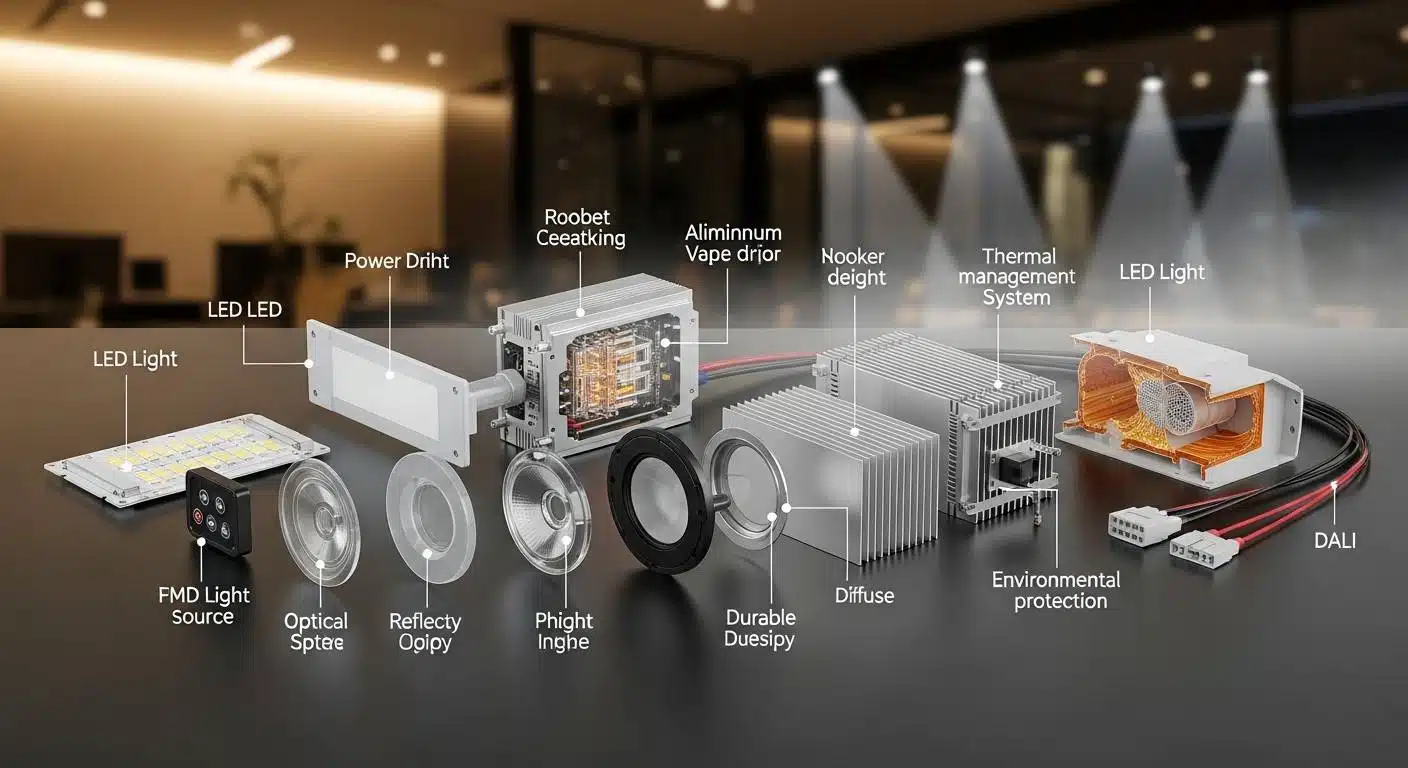
LEDs need precise power management, heat protection, and a consistent power supply to operate properly. A commercial LED lighting system typically includes several integrated parts:
- LED light source
- Power driver
- Thermal management system
- Optical components
- Housing and mounting structure
- Wiring and electrical connectors
- Control systems and sensors
Each component performs a specific function. When one part fails or is improperly designed, the entire system can experience issues such as flickering, overheating, voltage drop, or reduced lifespan.
For this reason, professional lighting manufacturers design LED lighting as complete electrical systems, not simply as standalone light fixtures.
Core Components of a Commercial LED Lighting System
| Component | Primary Role | Why It Matters |
|---|---|---|
| LED Light Source | Produces visible light | Determines brightness and color quality |
| LED Driver | Converts and regulates power | Prevents flicker and electrical damage |
| Thermal Management | Removes heat from LEDs | Extends lifespan and maintains efficiency |
| Optical Components | Shapes and directs light | Improves lighting quality and reduces glare |
| Housing & Mounting | Protects internal electronics | Ensures durability and stability |
| Control Systems | Enables automation and dimming | Improves energy efficiency |
| Wiring & Connectors | Maintains electrical continuity | Ensures safe system operation |
The system functions as a unified system which manages electrical power through its processes of regulation, conversion, distribution, and final transformation into usable light. The lighting system achieves its optimal performance through the correct design and matching of its components which function together as a system.
The LED Light Source: The Core of the Lighting System
At the center of every LED lighting system is the LED chip or module, which produces visible light.
Modern lighting products typically use surface-mounted device (SMD) LEDs, small semiconductor components mounted directly onto a printed circuit board or LED strip.
Understanding LED Chips and Packages
LED chips are commonly identified by their package dimensions. Some common LED packages include:
- 2835 LEDs
- 3030 LEDs
- 3528 LEDs
- 5050 LEDs
These numbers represent the size of the LED package in millimeters. For example, a 5050 LED, in principle, is said to measure approximately 5.0 mm * 5.0 mm.
Even though the size of the chip is considered, the luminous output is composed of numerous other factors.
Key Performance Characteristics of LED Modules
Important characteristics that define LED performance include:
- Lumen output – the total amount of visible light produced
- Efficacy (lm/W) – how efficiently electrical power is converted into light
- Color temperature – the warmth or coolness of light measured in Kelvin
- Color Rendering Index (CRI) – how accurately colors appear under the light
Another important factor is LED binning, which refers to sorting LEDs based on color consistency and brightness levels during manufacturing. High-quality lighting systems use tightly controlled bins to maintain uniform appearance across installations.
LED Strip Systems in Architectural Lighting
LED strips serve as common lighting solutions which architects and commercial designers utilize to achieve continuous illumination across walls and ceilings and shelving units and display spaces. Designers use strip systems to create linear lighting designs which deliver uniform brightness across their entire lighting layout.
LED Drivers: Regulating Power for Safe Operation
LEDs cannot run directly on standard building electricity. Commercial electrical systems deliver high-voltage alternating current (AC), while LEDs require low-voltage direct current (DC).
The LED driver converts and regulates this electrical power.
How LED Drivers Work
An LED driver performs three essential functions:
- Power conversion – converting AC power into DC power suitable for LEDs
- Current regulation – maintaining stable current levels to prevent flicker
- Electrical protection – protecting LEDs from voltage spikes and fluctuations
Without proper regulation, LEDs can draw excessive current, which may lead to overheating or premature failure.
Types of LED Drivers Used in Commercial Lighting
Two main driver types are commonly used.
Constant Current Drivers
These deliver a fixed current output while allowing voltage to vary depending on the LED load.
Constant Voltage Drivers
These provide a fixed voltage output (commonly 12V or 24V) and are widely used with LED strip lighting systems.
Driver Compatibility with Lighting Controls
Many commercial drivers also support dimming and automation through control protocols such as:
- 0–10V dimming
- DALI lighting control
- DMX control systems
The quality of the LED driver strongly influences overall system reliability. In many cases, driver failure is one of the most common causes of lighting system problems.
Thermal Management Systems: Protecting LED Lifespan
Although LEDs are energy efficient, they still produce heat during operation. This heat is generated inside the semiconductor junction. If heat is not removed effectively, the LED system may experience several issues:
- Lumen depreciation – gradual loss of brightness
- Color shift – changes in the perceived color of the light
- Reduced fixture lifespan
Common Thermal Management Solutions
Commercial lighting systems use several methods to manage heat.
Aluminum Heat Sinks
Aluminum serves as a common material because of its ability to transfer heat through its structure and release that heat into the surrounding environment.
Fin Designs
Heat sinks often use fins which operate as additional surfaces to expand their contact area with air, which results in better heat transfer performance.
Passive Cooling
Most lighting systems use passive cooling technology which enables them to dissipate heat without needing fans or any mechanical components to operate.
The fixture housing in many designs operates as an essential element of the thermal management system which helps transfer heat from the LEDs to other areas. Thermal management gains critical importance in commercial facilities which operate their lighting systems at high output levels for extended periods throughout the day.
Optical Components: Shaping and Controlling Light
LED chips naturally emit light in a wide pattern. Optical components help control how that light spreads across a space. Three types of optical elements are commonly used.
Lenses
Lenses use refraction to shape light into specific beam angles. This allows lighting designers to focus illumination on work areas or architectural features.
Reflectors
Reflectors redirect light using reflective surfaces. They are often used in directional fixtures such as downlights.
Diffusers
Diffusers spread light evenly and reduce glare. Materials such as frosted polycarbonate or acrylic are commonly used.
Functions of Lighting Optics
Optical components serve several purposes:
- controlling beam angles
- distributing light evenly
- reducing glare and hotspots
In environments such as retail stores, museums, and hospitality venues, proper optical design can significantly improve visual comfort and lighting quality.
Housing and Structural Components: Protecting the Lighting System
Lighting fixtures must protect electronic components while also providing structural support.
Structural Stability and Mounting
The fixture housing holds the driver, circuit board, optics, and electrical components in place. It also supports mounting hardware used during installation.
Environmental Protection
Lighting systems in commercial spaces need to function correctly when faced with dust and humidity and temperature variations.
Common protective features include:
- dust protection
- moisture protection
- outdoor and harsh environment IP-rated enclosures
Materials Used in Commercial Lighting Housings
Commercial LED fixtures are often manufactured from:
- aluminum
- aluminum alloys
The materials create products that resists damage while enabling efficient thermal cooling. The light fixture housing uses aluminum as its primary material because it effectively conducts heat to improve the lighting system’s thermal capabilities.
Control Systems: Smart Lighting and Automation
Many commercial lighting installations now include control systems that allow lighting to respond automatically to environmental conditions.
Common Lighting Controls
Occupancy Sensors
Detect movement and turn lights on or off based on room usage.
Daylight Harvesting Sensors
Measure natural light levels and adjust electric lighting accordingly.
Lighting Control Protocols
Advanced commercial lighting systems often use communication protocols such as:
- DMX512
- DALI
- Wireless lighting control systems
These systems allow multiple fixtures to operate together and respond to centralized control commands.
Benefits of Lighting Controls
Lighting control systems provide several advantages:
- reduced energy consumption
- automated lighting schedules
- improved building efficiency
Wiring, Connectors, and Protection Components
Electrical connections are often overlooked but play an essential role in system reliability.
Commercial LED lighting systems rely on:
- properly rated electrical wiring
- secure connectors and terminals
- electrical protection components
Protection Components
Important protection elements include:
- surge protection devices
- grounding systems
- electrical fuses
These components help protect lighting systems from electrical faults and maintain safe operation throughout the life of the installation.
How LED Lighting System Components Work Together
| Stage | Process | Component |
|---|---|---|
| Power Input | AC power enters system | Electrical supply |
| Power Conversion | AC converted to DC | LED driver |
| Light Generation | LEDs produce light | LED module |
| Heat Removal | Heat transferred away | Thermal management |
| Light Control | Beam directed and diffused | Optical components |
| Automation | Lighting adjusts dynamically | Control system |
The lighting system maintains constant brightness while using energy efficiently and operating reliably when its components function together according to their intended design.
Why Component Quality Matters in Commercial LED Lighting
The operational behavior of commercial lighting systems results in their usage for multiple thousand hours every year which necessitates high-quality components to ensure their extended operational life.
Several factors make system quality important:
- extended operating hours in commercial buildings
- strict electrical safety requirements
- maintenance costs for large facilities
The use of certified drivers together with properly tested LED modules and well-designed thermal systems results in a major decrease of operational problems.
The certification standards which include UL testing requirements help to verify that lighting systems will satisfy their safety and performance standards for electrical installations.
Reliable LED Lighting Starts With System Design
LED lighting functions as an illumination source. The system operates as a unified electrical network which connects various components to deliver secure and consistent light output.
The dependable commercial lighting systems which work together include three essential components.
- high-quality LED modules
- stable and efficient drivers
- effective thermal management
- properly designed optics
- safe electrical connections and controls
At SIRS-E, we design and manufacture LED strips, drivers, and lighting accessories in the United States. Our products use UL-certified components which undergo testing for actual installation conditions to deliver safe and dependable performance.
The complete performance of LED lighting systems depends on their components working together as one complete system. The correct combination of drivers with thermal management and optics and wiring components results in stable lighting performance which extends product lifespan.
Lighting installations benefit from initial system design because it helps to eliminate most installation issues that commonly occur during later stages of the project.
Frequently Asked Questions:
1. What are the main components of an LED lighting system?
An LED lighting system typically includes the LED light source, driver, thermal management system, optical components, fixture housing, control system, and electrical wiring.
2. Why is the LED driver important in commercial lighting?
The driver regulates electrical power supplied to the LEDs. Without proper current regulation, LEDs can flicker, overheat, or fail prematurely.
3. How does thermal management affect LED lifespan?
Heat is one of the main factors that reduce LED lifespan. Thermal management systems remove heat from the LED junction and help maintain consistent light output.
4. What control systems are used in commercial LED lighting?
Commercial lighting often uses control protocols such as 0–10V dimming, DALI, and DMX512, along with sensors for occupancy and daylight harvesting.
5. Why do commercial lighting systems require certified components?
Certified components, such as UL-tested drivers and electrical systems, help ensure lighting installations meet safety standards and operate reliably in commercial environments.

I’m the founder and CEO of SIRS Electronics, Inc. and an Electrical Engineer with nearly 30 years of experience in LED lighting, electronics, and product development. I focus on building practical, reliable lighting and control solutions for architectural, commercial, and entertainment applications.