
Why Museums and Art Installations Use Linear LED Lighting
Understanding 2835 LED strips is essential when selecting lighting for museums and art installations. These LED solutions provide precise control, low heat output, and safe illumination for sensitive artifacts.Understanding 2835 LED strips is essential when selecting lighting for museums and art installations. These LED solutions provide precise control, low heat output, and safe illumination for sensitive artifacts.
Lighting in a museum is never just about visibility.
- It protects fragile materials.
- It defines how visitors experience a space.
- It quietly determines how sustainable the building will be over time.
Museums design lighting around three priorities: preservation, visitor experience, and operational responsibility. Achieving all three at once is difficult. Traditional lighting systems often force compromises.
That’s where linear LED lighting fits in.
Linear LED systems give institutions precise control over light output, distribution, and spectrum. They reduce heat, limit harmful radiation, and deliver consistent illumination across exhibits. For museums looking to protect collections while modernizing their infrastructure, linear LEDs have become the practical choice.
At SIRS-E, we work with professional lighting environments where accuracy, safety, and reliability are non-negotiable. Museums fall squarely into that category.
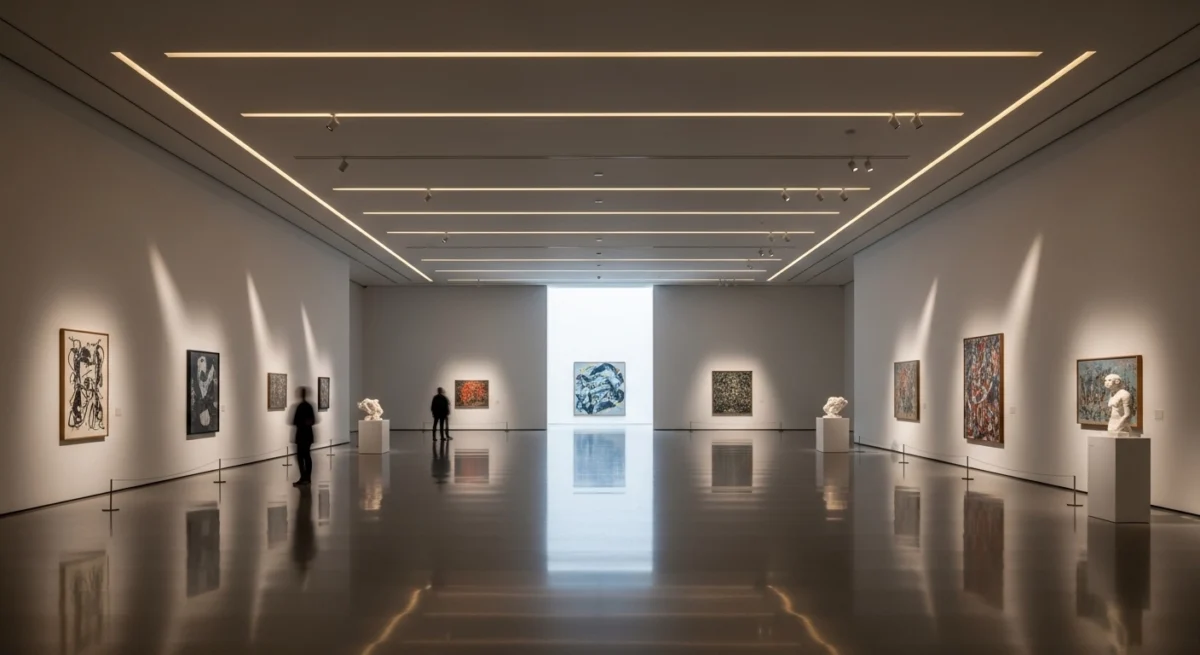
Why Linear LED Lighting Is the Professional Standard
What is Linear LED Lighting?
Linear LED lighting isn’t about technology names. It’s about how light behaves in a space.
Instead of placing a few bright fixtures and aiming them at an object, linear lighting spreads light out. It runs along a wall. Along a case. Sometimes hidden. Sometimes visible. But always continuous.
That changes how a room feels.
- You don’t see circles of light anymore.
- You don’t notice where one fixture ends, and the next begins.
- Your eye stops jumping between bright and dark patches.
Everything reads evenly.
That’s the reason museums lean toward linear systems. Not because they’re trendy. Because they remove distraction. The light does its job and stays out of the way. Track heads and spotlights still have a place. But they behave like tools. Linear lighting behaves like part of the architecture.
Key Advantages Over Traditional Lighting
1. Energy efficiency:
Well over half, sometimes close to 75%, is the reduction in lighting energy that many museums achieve after switching to LEDs. Traditional incandescent and halogen lamps waste a large portion of energy as heat, whereas LEDs use energy more efficiently. As a result, this shift delivers significant savings in real-world applications.
2. Long lifespan:
Maintaining lighting in museums is often difficult because access is limited and displays are sensitive. Therefore, frequent replacements are not practical. However, LEDs reduce maintenance needs significantly. In fact, a well-designed system can run for years and last many times longer than halogen or fluorescent lamps without constant attention.
3. Low heat output:
Heat is a critical concern in galleries, especially for delicate artwork. Unlike traditional lighting, which directs heat toward displays, LEDs produce minimal radiant heat. Consequently, this reduces strain on climate control systems and lowers the risk of damage to fragile materials.
Preservation: Protecting Artifacts with Minimal Damage
1. Light Damage Basics
- Light exposure causes gradual damage. It always has.
- Visible light contributes to fading over time.
- Ultraviolet radiation accelerates chemical breakdown.
- Infrared radiation introduces heat stress.
- Older lighting technologies emit all three in significant amounts.
Light exposure causes gradual damage, and it has always been a concern in preservation. Over time, visible light leads to fading, while ultraviolet radiation accelerates chemical breakdown. In addition, infrared radiation introduces heat stress that can further impact sensitive materials.
As a result, older lighting technologies emit all three types of harmful radiation in significant amounts. However, modern LED systems, when designed with proper techniques, produce minimal ultraviolet and infrared radiation. Therefore, they are much safer for delicate materials such as textiles, paper, paintings, photographs, and mixed-media artworks.
2. Controlled Exposure Is Key
Preservation depends on cumulative exposure, meaning damage builds slowly over time. Therefore, museums control this by setting strict lux limits and carefully managing exposure duration.
Moreover, linear LEDs support this approach effectively because they dim accurately and distribute light evenly. As a result, they eliminate the need for over-lighting to compensate for uneven coverage. Consequently, this level of control allows curators to meet conservation goals without compromising visual clarity.
3. Scientific Backing
Research in conservation consistently shows that properly selected LEDs cause less material degradation compared to halogen or incandescent sources. In other words, the outcome depends on quality, spectrum control, and correct application.
However, not all LEDs are inherently safe. Instead, only well-designed and properly specified systems deliver the intended protection and long-term reliability.
Visual Quality: Enhancing Artwork and Visitor Experience
1. High Color Rendering (CRI)
Color accuracy matters in museums. Visitors expect to see artwork as it was intended. CRI measures how accurately a light source reveals color. Poor CRI distorts tone, saturation, and contrast.
Modern LED technology can achieve high CRI levels comparable to traditional lamps, without the energy waste or heat output. That balance is what makes LEDs suitable for exhibition spaces.
2. Uniform Illumination with Linear LED
Linear LEDs excel at consistency.
- They illuminate surfaces evenly.
- They reduce glare.
- They eliminate harsh shadow transitions.
For visitors, this creates a calmer, more focused viewing experience. The artwork stays central. The lighting stays invisible.
3. Curatorial Flexibility
Exhibits change. Materials vary. Themes evolve.
Linear LED systems allow curators to adjust brightness and color temperature to suit different works. With modern controls, these adjustments happen digitally. No rewiring. No fixture relocation.
Lighting adapts without disruption.
Energy Efficiency and Operational Sustainability
1. Electricity Savings That Matter
Museums experience their highest energy consumption through their lighting system. The system consumes up to 20 percent of total energy usage in various facilities. The implementation of LED systems results in immediate energy savings.
The savings from this solution will continue to build up throughout the years.
2. Reduced Maintenance Costs
LEDs last longer. That sounds simple, but it has real consequences.
- Fewer lamp changes mean less labor.
- Less lift access near exhibits.
- Lower risk to staff and collections.
Maintenance becomes predictable instead of constant.
3. Environmental Benefits
Lower energy use supports broader sustainability initiatives. Reduced waste supports long-term stewardship. For institutions planning decades, these gains are meaningful.
4. Case Support
Museums that switch to LED lighting experience both decreased operating expenses and decreased need for maintenance work. The financial case aligns with the conservation case.
Design and Installation Considerations for Museums
1. Placement and Fixture Choices
Linear LED lighting can be surface-mounted, recessed, or integrated into architecture. Each approach requires careful planning.
- Spacing matters.
- Angles matter.
- Diffusion matters.
The goal is even illumination without glare or hotspots. Diffusers and proper beam control help achieve that balance.
2. Integration With Controls
Linear LEDs integrate cleanly with DMX and smart control systems. This allows dimming, scene presets, occupancy-based adjustments, and daylight harvesting.
Lighting responds to the space instead of remaining static.
3. Safety and Compliance
Museum installations demand compliance. UL-certified components, proper wiring, and professional installation are essential, especially for long linear runs.
At SIRS-E, safety and documentation are part of how we support professional projects. Lighting should never introduce risk.
Real-World Applications of Linear LED in Museums
1. Gallery Highlighting
Linear LEDs are ideal for illuminating long walls and display cases. Color stays consistent across the viewing area. Brightness remains controlled.
2. Interactive or Sculptural Displays
Mixed-media exhibits often need adaptable lighting. Linear LED systems allow tuning for different materials without redesigning the layout.
3. Architectural Illumination
Linear LEDs are often used in corridors, ceilings, and transition spaces to guide movement. The light stays even and quiet. It helps visitors navigate without pulling focus away from the collection. When done right, you don’t notice it. You just move comfortably through the space.
4. Smart, Adaptive Lighting Scenarios
Lights dim when spaces are empty and return to normal during visiting hours, cutting energy use without affecting how the space feels.
Comparing Linear LED to Other Lighting Technologies |
|
|---|---|
| Lighting Type | What to Know in Museum Settings |
| Halogen / Incandescent | Runs hot, burns out quickly, and requires frequent replacement. Heat and maintenance make it a poor fit near sensitive collections. |
| Fluorescent | Uses less power than halogen, but can introduce flicker, uneven color, and mercury handling concerns. |
| Linear LED | Low heat output, long operating life, stable color, and precise control over brightness and spectrum. |
The Future of Museum Lighting
Museums select linear LED lighting because it provides effective results. The lighting system protects artifacts while displaying artwork in authentic colors and creating minimal operational expenses. The lighting system used by institutions that hold permanent collections serves as a strategic decision.
Do you want to improve your museum or installation space using professional-grade LED solutions that have obtained UL certification?
Please reach out to SIRS-E, so we can understand your needs and provide you with expert advice designed for conservation-based environments.
Frequently Asked Questions:
What makes linear LED lighting ideal for museum exhibits?
Even illumination, low heat output, and accurate color rendering make linear LEDs well-suited for conservation and display.
Are LEDs safe for delicate artifacts?
High-quality LEDs emit very little UV or IR, reducing light-related damage compared to older lighting technologies.
How much energy can a museum save by switching to LEDs?
LED systems can reduce lighting energy use by up to 75%, depending on the existing setup.
Can linear LEDs be dimmed or color-tuned?
Yes. Most modern systems support precise dimming and color temperature adjustment through control systems.
Do museums need special LED fixtures?
Yes. Museum-grade lighting requires controlled spectrum, high CRI, and compliance standards that not all LED products meet.